• Home
  • 授業料・クラス一覧
  • レッスン内容
  • 今月の休み
  • プロフィール
  • 生徒さんの声
  • 翻訳・編集
  • ブログ
  • Word
  • Resources
  • Mistakes
  • Contact

スピーク英会話サロン【福岡】

  • Home
  • 授業料・クラス一覧
  • レッスン内容
  • 今月の休み
  • プロフィール
  • 生徒さんの声
  • 翻訳・編集
  • ブログ
  • Word
  • Resources
  • Mistakes
  • Contact
  • Menu

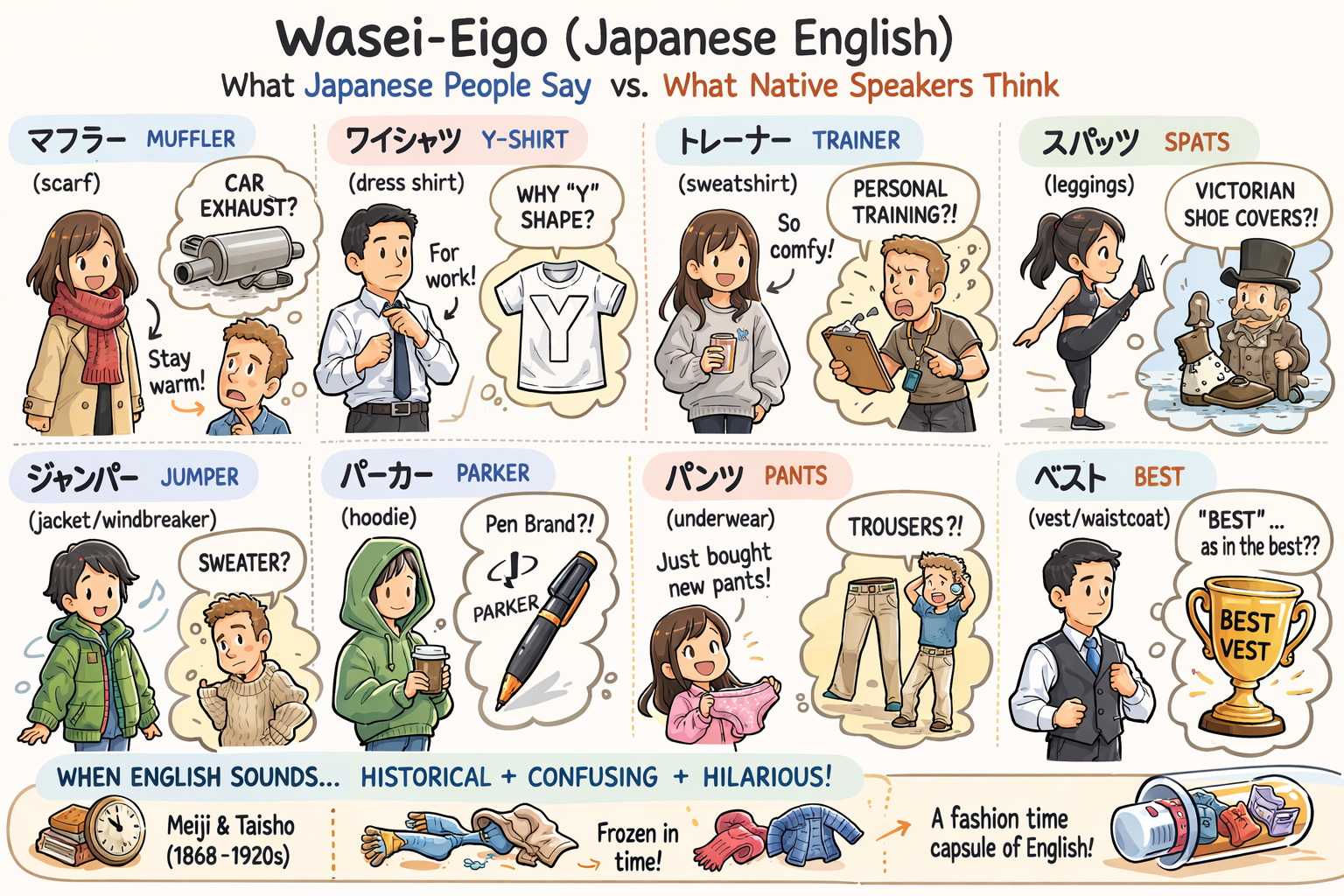
When English Becomes a Time Capsule: Funny Wasei-Eigo Clothing Words

March 16, 2026

If you study English in Japan, you probably know that many everyday words come from English.

But sometimes those words mean something a little different from what native speakers expect.

These words are called 和製英語 (wasei-eigo) — English words that were created or changed in Japan.

Some of them are funny. Some are confusing. And some are like a time capsule, preserving English from more than 100 years ago.

Let’s look at a few examples.

Muffler (マフラー)

In Japan:

マフラー = scarf

But if you say “muffler” in modern English, people will think of a car muffler — the metal part connected to the exhaust.

However, in older British English, “muffler” actually did mean a scarf.

That meaning slowly disappeared in English during the 20th century, but Japan kept it.

So Japanese English preserved an older word that native speakers rarely use today.

A linguistic time capsule!

Y-Shirt (ワイシャツ)

This one has an interesting history.

When Western clothes first came to Japan in the late 1800s, most dress shirts were white.

People heard the words “white shirt.”

Over time, this became:

white shirt → wai shatsu → ワイシャツ

Today, ワイシャツ simply means a dress shirt, even if it isn’t white.

But if you say “Y-shirt” in English, native speakers will probably imagine a shirt shaped like the letter Y.

Trainer (トレーナー)

In Japan:

トレーナー = sweatshirt

But in English, a trainer is usually:

• a fitness coach
• a sports instructor
• (in the UK) running shoes

The Japanese meaning probably comes from the idea of training wear.

Pants (パンツ)

This one often causes funny misunderstandings.

In English:

pants = trousers

In Japanese:

パンツ = underwear

So when a Japanese learner proudly says:

“I bought new pants today.”

A native speaker might imagine new trousers, not underwear!

Parker (パーカー)

In Japan:

パーカー = hoodie

But English speakers usually say hoodie.

The Japanese word probably came from parka, the heavy winter coat with a hood.

Over time the pronunciation changed to パーカー (pākaa).

To English speakers, though, “Parker” sounds like a brand of pen.

Spats (スパッツ)

Today in Japan:

スパッツ = leggings

But in English, spats were something very different.

They were small covers worn over shoes in the late 19th and early 20th century.

You can see them in old photos of bankers, politicians, and early automobile drivers.

Again, Japan kept an old word but gave it a new meaning.

English Frozen in Time

Many English clothing words entered Japan during the Meiji and Taishō periods (late 1800s–early 1900s) when Western fashion first became popular.

At that time, Japan borrowed English words and adapted them to Japanese pronunciation.

But languages continue to change.

Over time, English speakers stopped using some of these words, or their meanings changed.

Japan kept them.

That’s why many wasei-eigo words feel like a little museum of old English.

A linguistic time capsule from another era.

A Small Pronunciation Time Capsule

You can even hear this in pronunciation.

Many Japanese speakers pronounce the “wh-” sound clearly:

• who
• white
• where

Older English once made a stronger distinction between w and wh sounds.

Most modern speakers no longer do this.

So in a strange way, Japanese learners sometimes preserve an older pronunciation of English too!

Why This Is Actually Wonderful

Wasei-eigo isn’t “wrong.” It’s simply how languages change when cultures meet.

English influenced Japanese.

Japanese reshaped those words.

And now those words tell a small story about history, fashion, and language.

So the next time someone in Japan says:

“I need my muffler.”

Don’t imagine a car.

They’re just trying to stay warm.
In Vocabulary Tags 英会話, 英会話福岡市, 英会話英会話, 和製英語
Comment

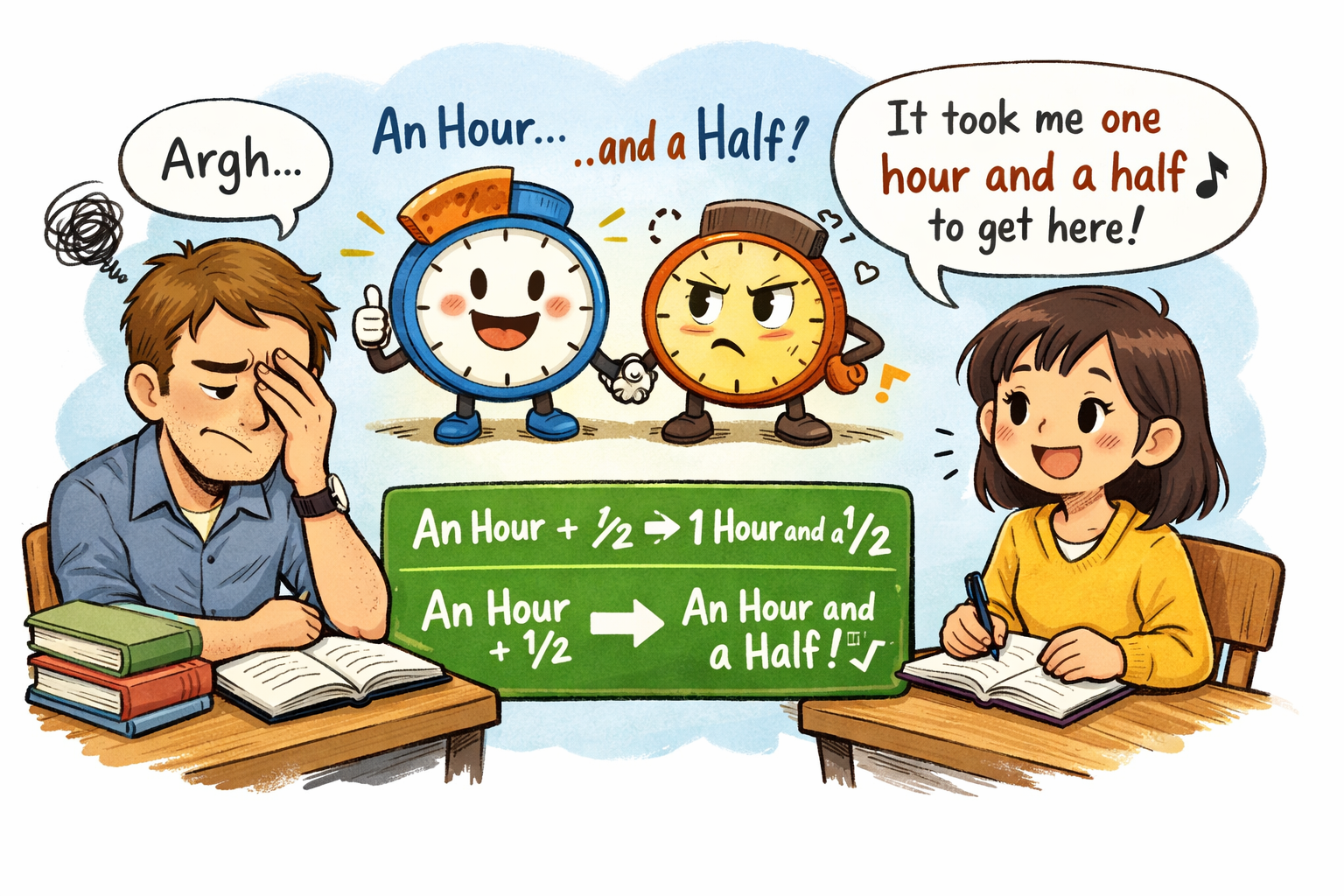
Why “One Hour and a Half” Drives English Teachers Crazy

March 6, 2026

After teaching English in Japan for many years, there is one sentence that I hear again and again:

“It took me one hour and a half to get here.”

Now, this sentence is perfectly understandable. No native English speaker would have trouble understanding it.

But it is not quite natural.

In English, we usually say:

“It took me an hour and a half.”

Why?

Because “hour and a half” works like a single unit of time.

Think of it like this:

✔ an hour and a half
✔ two hours and a half (less common)
✔ two and a half hours (best)

Examples:

  • It took an hour and a half to finish the movie.

  • The meeting lasted an hour and a half.

  • I studied English for two and a half hours yesterday.

Many Japanese students translate directly from

一時間半

which leads to “one hour and a half.”

Again — not wrong! Just slightly unnatural.

These small differences are exactly the kind of thing we practice in our conversation classes.

Learning grammar is important, but learning natural English is what makes conversation really smooth.

And who knows — maybe next time it will only take you an hour and a half to get here!

In Common Mistakes Tags 英語, 英会話, 英語学習, 英語勉強, 英会話中央区, 英会話福岡市, 今泉英会話, 薬院, 天神南
Comment

Boys of Summer

August 13, 2023

This was a fun surprise.

Spent most of the day indoors, but in the afternoon my older son wanted to go out and shoot hoops and play catch, so we went to “Yakuin Park”. About an hour later, a large group of tanned kids in sandals showed up. Judging by the buzz cuts most of them had, I figured they were baseball players, but not from these parts.

After chatting and playing with them for about an hour, I learned that they were from Nakagusuku Village, Okinawa, a small town in the middle of the main island, close to Ginowan and the massive Kadena Air Force Base. As I suspected, most of them had distinctly Okinawan family names—Kinjo, Miyagi, and so on. They also had more brothers and sisters than the typical Japanese family. Okinawans are famous for having larger than average families and none of the kids I talked to were only children; all but one had more than two siblings.

They came to take part in a baseball tournament, something they try to do every year and use the Campfire crowdsourcing to fund the trip. (I will be happily donating to the cause in the future.)

When they left, one of the younger boys hugged me. Another, who had been playing basketball with my younger son, told him to come down to Nakagusuku and play with him there. They were all so sweet.

I guess because they were from Okinawa and used to seeing the mixed-race kids of the US military personnel, they had no qualms about approaching us and talking. So very different from kids here in Fukuoka who can be more standoffish towards outsiders.

Later, I googled their school, Nakagusuku Minami. It’s a new school with over 700 students. Liam’s own school has about 600, but Akasaka Elementary which is in the next district has much fewer. Unlike schools here in Fukuoka which are being merged to maintain enrollment, their school was created due to overcrowding at another school.

Our little park hardly has any kids in it most times—the heaviest users are my own two boys—so it was nice to see it packed with kids, spontaneously playing different games and filling the air with their laughter.

In Family Life Tags Basketball, Okinawa, Nakagusuku Minami, Baseball, Fukuoka, 英会話, 英会話スクール, 英会話福岡市, 福岡英会話教室
Comment

Road Trip to San Diego

May 29, 2023

パームスプリングスから車でサンディエゴに移動します。

ハイウェイだと2時間ぐらいで着きますが、アメリカの道路に不慣れなので、山道を通るルートで行くことにしました。

街灯もない。ガードレールもない。夜の運転は恐ろしいですね…

南カリフォルニアのコロラド砂漠にあるCoachella Valley

カリフォルニアの乾燥した景色を堪能できます。

彼の名前はSMOKEY

山火事のお知らせをしてくれます。

山火事の跡も残っていました

今年のアメリカの冬は、カリフォルニアの砂漠に大雨が降るほど異常気象だったそうです。

山の方はまだ雪が残っていました。

こんなに山が緑なのを初めて見ました。

In California, Life in California, Life in America Tags カリフォルニア, アメリカ, 英会話福岡市, 福岡市英会話教室, 福岡市英語
Comment

Palm Springs Life

May 22, 2023

パームスプリングスは広い一軒家が多い地域になります。

広いリビング

寒い日は暖炉で暖まります。

広いキッチン。鬼ごっこができそうです。

nap time

細長ーーーいプール

温水にする機能がついているので、外が少々寒くても入れます。

携帯電話から温める操作ができるそうです。ハイテクですね。

とうっ!!!

splash!!!

夜は外の暖炉を囲んで、おしゃべりに花を咲かせます。

5日間のパームスプリングを家族と堪能することができました。

次はサンディエゴへ車で移動です。

In California, Family Life, Life in California, Life in America Tags Palm Springs, 英会話福岡市, 英会話教室福岡市, California
Comment

Our neighbor’s home

The Architecture of Palm Springs

May 12, 2023

Two main styles of architecture predominate in Palm Springs—Mid-century modern, as I have mentioned in a previous post, and the “hacienda” style. I am a big fan of both.

Homes designed in the Mid-Century fashion in Palm Springs are usually single-story, with geometric rooflines. Most of these houses were built in the 1950s and 60s.

According to Wikipedia, the movement behind mid-century modern architecture (1950s/60s era) in Palm Springs is backed by architecture enthusiasts, designers, and local historians to preserve many of Palm Springs' buildings and homes of famous celebrities, businessmen, and politicians. Stores sell furniture and gifts that feature a mid-century modern theme. The city holds a Modernism Week celebration every February, along with several related smaller events during the year.”

The other style is called hacienda.

Again, Wikipedia, “The term hacienda is imprecise, but usually refers to landed estates of significant size, while smaller holdings were termed estancias or ranchos . . . In Mexico, as of 1910, there were 8,245 haciendas in the country. In Argentina, the term estancia is used for large estates that in Mexico would be termed haciendas.

“In recent decades, [however] the term has been used in the United States for an architectural styleassociated with the traditional estate manor houses.”

The hacienda style that you can find in Palm Springs typically have reddish brown tiled roofs, white or beige stucco wallswith plants growing up them, colorful shuttered windows, and covered patios.

In Life in California, California Tags Palm Springs, Las Palmas Palm Springs, Architecture in Palm Springs, Mid-Century Modern, Hacienda Style Architecture, 英会話, 英会話スクール, 英会話福岡市, 福岡英会話教室
Comment

Palm Springs 1

May 7, 2023

Our first destination on this trip was Palm Springs.

Palm Springs is a small city of about 40,000 people, located about 2 hours east of Los Angeles.


When I was a child, my father bought the home pictured below with some of his coworkers who were all in the real estate business (不動産業界). During the spring and autumn months we would spend about one weekend a month at the Palm Spring house, swimming in our pool, playing in the local park, taking walks in the evening, and eating at our favorite Mexican restaurant. It was truly a happy time for all of us.

About ten years later, my father sold that house and bought another slightly bigger one in the nicer Las Palmas neighborhood of Palm Springs. Here, our neighbors included the famous statesmen Henry Kissinger and actor Rock Hudson. All of the houses, or at least most of them, were designed by the same architectural company, so they have a similar style that is very Mid-Century Modern.

This was the house across the street from ours ↓

Although it may look dry—and to be honest, it is—this view is one I love. Palm trees, Mid-Century Modern architecture, the mountains and blue skies.

When we had the house, most of our neighbors had laws in front of their homes. The drought (干魃) of the past two decades has caused everyone to turn their gardens into desert ones.

Here is a more iconic image of Palm Springs. Golf course, palm trees, blue skies and mountains. As you can see from the photo, there is snow on those mountains. The highest mountain is San Jacinto. It is about 300 meters lower than Mount Fuji and can get a lot of snow. The water in the local springs come from that snow.

There is a tram that goes from Palm Springs all the way up into the mountains. I must confess that I have never been on it.

We meant to go up into the mountains this time, but it was too cold and rainy.

In California, Life in America, Life in California Tags California, Growing Up in California, Palm Springs, Las Palmas Palm Springs, Mid-Century Modern, 英会話, 英会話スクール, 英会話福岡市, 福岡英会話教室
Comment

Supermarkets in America

May 6, 2023

One of the things I love to do when traveling abroad is to visit local supermarkets. It can be so revealing (啓発), providing you with valuable insight (見識) into the daily lives of the people who live there.

When it comes to supermarkets in America, the first thing that hits you is the size. They are HUGE (広大), the aisles wide enough to drive a Japanese compact car (軽自動車) down them.

The second thing that will impress, or shock, you is the amount of processed, instant and frozen food there is.

The frozen food section at our supermarket in Fukuoka looks like this:

The frozen food section at the Ralph’s in downtown Los Angeles looked like this:

What’s more, there were about six of these gigantic freezers. The frozen food section alone was bigger than our local Bon Repas supermarket.

It was the same with just about every section of the supermarket.

The cereal section at our local Bon Repas.

There were two walls of cereal at the Ralph’s in LA.

Chips at our local supermarket.

Chips at a supermarket in Palm Springs. There were so many different types, we couldn’t decide what to buy.

In California, Life in America, Life in California, Life in Fukuoka, Life in Japan Tags Supermarkets in America, アメリカのスーパー, アメリカでの買い物, Grocery Shopping in America, 英会話, 英会話福岡市, 福岡英会話教室, Ralph's Supermarket
Comment

America

April 26, 2023

From March 17th to April 6th, we traveled to America. Well, actually, just Southern California. It was our first trip back to the US in almost five years. Five Years! We had originally planned to return in the summer of 2020, but then the Covid-19 pandemic closed the world down. It was good to be back, as you can see from the excitement in my face.

In the coming days and weeks, I will be sharing our adventures.

Stay tuned!

In Traveling with Kids, Life in California, Life in America Tags Southern California, America Trip, 英会話, 英会話教室, 英会話福岡, 英会話福岡市, スピーク英会話サロン
Comment
ftd2.jpg

FTD the floral-gifting experts

December 7, 2021

アメリカのお母さんへお花を贈りました。

アメリカに住んでいる人へお花を贈りたいときはFTDがおすすめです。

FTD  → https://www.ftd.com/?cid=ftddts&prid=ftddts

FTDは日本版花キューピットのアメリカ版で、the floral-gifting expertsだそうです。

ftd3.gif

贈り先の近くの花屋さんが花束を作り、届けてくれます。

ftd1.jpg

アメリカにいる大切な人への贈り物に

ぜひご利用ください!

In Life in America, Life in Fukuoka Tags FTD, 花, 贈り物, speak!英会話サロン, 英語福岡市, 英会話福岡市
Comment
IMG_1595.jpg

Hydrangea

June 3, 2021

あじさいの季節です。

梅雨入り後、しばらく雨が降らなかったのですが、

またどんよりとした梅雨らしい空になりました。

IMG_1582.jpg
IMG_1597.jpg

鮮やかなピンクが綺麗です

IMG_1588.jpg
IMG_1594.jpg

お散歩が楽しい季節です

In Life in Fukuoka Tags 紫陽花, 梅雨, 英語福岡, 英会話福岡市, speak!英会話サロン
Comment
logo.png

News Eigo Jutsu

December 22, 2020

NHK’s ニュース英語術 is a great site to help you improve your reading ability, particularly when reading news stories.

Almost every weekday, one short article is uploaded. If you have trouble understanding the sentence, click on the arrow to reveal not only a translation of the sentence, but also grammar and vocabulary pointers.

In Reading Tags NHK’s ニュース英語術, Reading, How to improve your English, Improve Your Reading Skills, English News, 英会話, 英会話スクール, 英会話福岡市
Comment

Christmas in the US and Britain

December 22, 2020

You may think that just because Americans and the British speak the same language and share a connected history they must also celebrate Christmas the same way.

Well, actually, we don’t.

The customs and traditions are quite different, though, thanks to Hollywood movies and TV shows, the British Christmas is becoming more and more like America’s.

In Comparative Culture, Holidays, Life in America, Life in the UK Tags Christmas Traditions in America and the UK, American vs British Christmas, Christmas, 英会話, 英会話スクール, 英会話福岡市
Comment
7RR6JSDVXFFYNE53TDZ3Q4QO4U.jpg

What's Santa's Name?

December 10, 2020

How many different names for Santa Claus can you think of? I come up with ten, many of which are just variation of Saint Nicholas or Father Christmas.

The following was taken from Busuu. You can read the entire article here.

What is Santa Claus’ real name?

The concept originated from Saint Nicholas, a patron saint famous for giving generous gifts to the poor. The pronunciation of Saint Nicholas in Dutch is Sinnterklaas, which is where the name Santa Claus came from. Spelling Sinterklaas as Santa Claus dates back about 200 years in New York.

10 different names for Santa Claus around the world

1. English: Santa Claus / Father Christmas

In the UK, US and Canada, “Santa Claus” or “Father Christmas” is believed to travel around the world sporting a red suit on his sleigh, pulled by reindeer. 

He comes down the chimney the night before Christmas (between 24 and 25 December), leaving presents for children under the Christmas tree! Children often leave Christmas stockings by the fireplace that Santa can fill with small gifts and sweets. 

Some families will leave a snack for him for his travels. In the UK, it’s common to leave a mince pie (a traditional festive pastry) and a glass of whisky / sherry for Santa, and a carrot for the reindeer! Americans leave cookies and milk.

2. American-English: Kris Kringle

In the US and Canada, some people call him Kris Kringle, which originates from the German word Christkind (Christ child). 

3. French: Père Noël / Papa Noël (lit. Father Christmas / Daddy Christmas)

In France, it is Père Noël who delivers presents either on the eve of 23rd December, or on the morning of 25th December. 

In the east of France, he is accompanied by Le Père Fouettard, a man dressed in black, who is said to punish the children if they misbehave.

3. Spanish: Papa Noel (lit. Father Christmas)

The man behind the Spanish name for Santa Claus is commonly known to give out presents on 24th December or 25th December (from Papa Noel), or on 6th January (from the Three Kings). 

In South America, a family member often dresses up as Papa Noel and gives gifts to the children.

While in countries like Mexico and Venezuela, presents might also be brought by El Niñito Dios (baby Jesus) or Santo Clós (Santa Claus).

Santa is actually Spanish and means “saint”. The only problem is that Santa with an “a” is used for women, such as Santa Maria, Santa Barbara, Santa Clara. Men use “San” or “Santo”, as in San Francisco, San Diego, San Antonio, etc.

4. German: Weihnachtsmann (lit. Christmas man)

The festive season in Germany starts early, with Nikolaustag – St. Nicholas Day – on 6th December. It is thought that St. Nicholas comes in the night, and puts presents in the children’s shoes, which are usually polished (kids have got to get in Santa’s good books somehow!) and placed by their front doors the evening before.

In some parts of Germany, das Christkind (Christ child) is thought to bring children presents on Christmas Eve. Children also write to him asking for presents before Christmas. They even decorate their letters by gluing sugar to the envelope!

In other parts of the country, der Weihnachtsmann (Santa Claus) is the one who brings presents to the children. Traditionally, German people open their presents on Christmas Eve rather than Christmas Day.

5. Italian: Babbo Natale (lit. Daddy Christmas)

In Italy, Babbo Natale is thought to deliver presents at Christmas. Italian families start collecting presents at the start of December and they are opened either on Christmas Eve or on Christmas morning. 

It is also believed that the witch, La Befana, arrives during the night of 5th January bringing smalls gifts, sweets and dried fruits which she leaves in the socks of the good children.

6. Portuguese: Papai Noel (lit. Father Christmas)

In some parts of Brazil, children leave a sock near a window. If Papai Noel finds their sock, he’ll exchange it for a present.

In Portugal, Santa Claus is called Pai Natal. He is believed to bring presents to children on Christmas Eve. Presents are left under the Christmas tree or in shoes by the fireplace.

In both countries, families will either open presents on the eve of the 24th after Midnight Mass or on Christmas morning.

7. Russian: Дед Мороз – Ded Moroz (lit. Grandfather Frost)

In Russia, Christmas is actually celebrated on 7th January, which is the Orthodox Christmas, and therefore goes by a different calendar. This is true for many Easter Orthodox Christian denominations, such as those in the Middle East.

However, people do also exchange presents on New Year’s Eve. It is believed that Ded Moroz (the Russian and interpretation of and name for Santa Claus) brings presents with the help of his granddaughter, Snegurka. The tradition goes that children make a circle around the Christmas tree and call for Ded Moroz and Snegurka. When they appear, the star and other lights on the Christmas tree light up.

8. Turkish: Noel Baba (lit. Father Christmas)

Christmas isn’t widely celebrated in Turkey, but some families celebrate popular Christmas traditions on New Year’s Eve. They might have a ‘New Year’s Eve tree’ and give gifts.

9. Polish: Święty Mikołaj (lit. Saint Nicholas)

In Poland, it is generally believed that Święty Mikołaj brings presents which are opened after the Christmas Eve supper is finished. Sometimes the adults tease the children by dragging out the meal so they have to wait longer for the presents!

In some parts of Poland, there are different traditions. In the east, presents are given by Dziadek Mróz (the same as Ded Moroz in Russia) and in western and northern Poland people believe that Gwiazdor (the starman) brings them.

In Comparative Culture Tags Different names for Santa Claus, Origin of Santa Claus, Santa Claus, Father Christmas, Christmas Traditions around the World, 英会話, 英会話教室, 英会話福岡市
Comment

Peacock Lane

December 9, 2020

Peacock Lane is a four-block street in southeast Portland, Oregon, in the United States. It is known for its elaborately decorated homes during the Christmas and holiday season. During this time of year, thousands of people come to view the displays, buy cocoa, take horsedrawn carriage rides, and sing. The street earned a listing on the National Register of Historic Places in 2017.

The tradition of decorating thehouses dates backto the 1920s. Since beginning, the event has occurred annually, except for a short interruption during World War II while the United States was rationing valuable resources, including electricity.

Many homeowners voluntarily pass along their decorations to new residents when they sell their properties. Homeowners are not obligated to put up any lights or displays, but most do.

In Holidays, Life in America Tags Portland, Oregon, Christmas Lights, 英会話, 英会話福岡市
Comment

Christmas Tree Farms

December 8, 2020

One thing I miss doing is going to Christmas tree farms and picking out a tree. These videos show what it is like.

In Holidays Tags Christmas, Christmas Tree, Christmas Tree Farm, 英会話, 英会話福岡市
Comment
676245_00009.jpg

The Seasons of Fukuoka Tower

December 4, 2020

Fukuoka Tower has really upped its illumination game in recent years.

43adcfd86ece0a937b1711f2bb963eec-1024x840.jpg
Tags 福岡タワー, Fukuoka Tower, Christmas Lights, イルミネーション, 英会話, 英会話スクール, 英会話福岡市
Comment
IMG_6905.jpg

LeBRETON

October 24, 2019

今泉にあるフレンチカフェ

ル・ブルトンのマカロン

present.jpg

包装もオシャレです。

IMG_6903.jpg

カラフルで可愛くて、贈り物に喜ばれます。

IMG_6900.jpg

彼はマカロンよりこちらがいいそうです。

いつ行っても幸せな気持ちになるカフェです。

ル・ブルトン → http://www.lebreton.jp

In Cafe Life, 甘いもの Tags LeBRETON, ル・ブルトン, クレープ, カフェ, 福岡英語, 英会話福岡市, Speak!英会話サロン
Comment
taiwan2.jpg

Summer Souvenir from Taiwan

August 29, 2019

なんて、なんて、おしゃれで華やかなパッケージでしょう!

こんなに素敵な包装のお土産をいただけて、本当に嬉しいです。

これは何かと言いますと、


台湾の定番土産パイナップルケーキです!!!


taiwan.jpg

箱もとっても素敵です。

大倉久和大飯店(オークラプレステージ台北)1階にある

ベーカリーThe Nine 烘焙坊のパイナップルケーキだそうです。

Speak!英会話サロンの同じクラスの生徒さん3人が

ものすごーく仲良くなられて、女性3人で旅行に行かれ、

そのお土産としていただきました。

そんなに仲良くなっていただけたことに驚きです!

英語だけでなく出会いの場も提供できて、こちらも嬉しいです!

ありがとうございました。

・The Nine 烘焙坊 → http://www.okurataipei.com.tw/zh-tw/餐廳介紹/The_Nine%20烘焙坊(1F)

In Souvenirs, 甘いもの Tags パイナップルケーキ, 台湾土産, 英語福岡, 英会話福岡市
Comment
chinsuko.jpg

Souvenir from Okinawa and Kyoto

June 17, 2019

沖縄土産に「ちんすこう」をいただきました。

ここ10年ぐらい、ちんすこうは美味しく改良され

お土産人気を盛り返しましたね。

しっとりとした口当たり。ほんのり甘いミルクの味。

IMG_6567.JPG

クッキーとはまた違う食感で、とても美味しいです。

IMG_6571.JPG

そして、京都土産に、

聖護院八ツ橋をいただきました。

ニッキの独特な味が苦手な方も多いと思いますが

苦手な方でも食べられるように?

だいぶ控えめに味付けしてありました。

さすがは京都土産、箱が可愛い

ですね。

In Souvenirs, 甘いもの Tags ちんすこう, 沖縄土産, 八ツ橋, 京都土産, 英会話福岡市, 英会話福岡
Comment
No results found

Instagram

Back at Sri Lanka Nishijin today. Never gets old.
Curry Tiner’s South Indian Chicken & Mutton Curry

I have been following the guy for years on Instagram and have been meaning to go, but the planets never quite seemed to line up. Today they did and thank God for that.

Wow!

Expect a long
Ippodo Tea Shop, Kyōto
Higashi Hongan-ji, Kyōto
All ready for Thanksgiving.

#shochu #imojochu #焼酎 #いも焼酎
Display Cases of Kyoto
Inukaeshi in Kyōto 

京都の犬返し

#Kyoto #Inukaeshi #犬返し #京都 #Machiya #町屋
Walls in Gokusho Machi, Hakata
The 15th of August is the last day of the Bon Festival of the Dead, Japan’s version of Dia de muertos. On this day, Japanese say goodbye to the spirits of their ancestors. Today I say goodbye to my last drop of Yamato Zakura Beni Imo 35%. Forgi
Azaleas at Fukuoka’s Kushida Shrine 

#櫛田神社 #Kushida #springinjapan #Fukuoka
Mugon (Tacit, lit. Without Words) rice shōchū genshu from Sengetsu Distillery of Hitoyoshi, Kumamoto. Aged in cypress casks, I believe, it retains that telltale hinoki scent. I normally don’t drink Kuma-jōchū, but this is lovely. I’ll buy
Another one of my somewhat hard-to-find favorites. Sang Som from Thailand. So smooth. I used to keep a bottle of it at Gamaradi before the pandemic. May have to do so again. Missed it. Missed Mr. Chang.
ブログ RSS
Unknown.jpeg
Featured
4c0a6231-58c1-450e-8f3a-bf718f86ea48.png
September 10, 2026
Win or Beat?
September 10, 2026
Read more →
September 10, 2026
Posessive Pronouns.png
September 2, 2026
Possessive Pronouns
September 2, 2026
Read more →
September 2, 2026
79a452f9-f4a0-4760-886d-544c736d0118.png
April 9, 2026
❌ "It is beautiful sea." — Why This Sentence Sounds Strange in English
April 9, 2026
Read more →
April 9, 2026
Avoiding Should.png
March 28, 2026
Why Many Japanese Avoid “Should” — And Why They Shouldn’t
March 28, 2026
Read more →
March 28, 2026
cde4019a-29a3-48cd-aa3c-880d433105fc.png
March 7, 2026
Why English Teachers Secretly Panic When Students Say “Good Taste!”
March 7, 2026
Read more →
March 7, 2026
c31b89c7-2fdd-441e-87ff-6af1ad634b1d.png
May 9, 2025
Admit vs Accept
May 9, 2025
Read more →
May 9, 2025
Die Of:From:In.png
April 12, 2025
Die Of/From/In
April 12, 2025
Read more →
April 12, 2025
Pan Ya Ya.jpg
November 19, 2024
Pan Ya Ya
November 19, 2024
Read more →
November 19, 2024
Shohei English.jpg
November 18, 2024
Shohei's English
November 18, 2024
Read more →
November 18, 2024
Screenshot 2024-03-12 at 4.30.42.png
March 13, 2024
By My Car
March 13, 2024
Read more →
March 13, 2024
Blog Photo.jpeg
Featured
What about:How about (kuroko).png
September 17, 2026
What About…? vs. How About…?
September 17, 2026
Read more →
September 17, 2026
Blog - Stuff.png
September 16, 2026
The Most Important English Word You Were Never Taught: “Stuff”
September 16, 2026
Read more →
September 16, 2026
American Cursive.png
September 14, 2026
Cursive Writing
September 14, 2026
Read more →
September 14, 2026
426b7067-f48b-47be-8112-182c79de9fa4.png
September 9, 2026
Why English Speakers Say “Twenty Twenty-Six”
September 9, 2026
Read more →
September 9, 2026
Malay Duplication.png
August 29, 2026
Reduplication in Languages
August 29, 2026
Read more →
August 29, 2026
c037c2d6-ac46-420e-abba-47c9bd494cc8.png
August 21, 2026
Katakana Does Not Always Mean English!
August 21, 2026
Read more →
August 21, 2026
Sentence Building Blocks.png
May 17, 2026
Sentence Building Blocks
May 17, 2026
Read more →
May 17, 2026
Why do Fukuoka Schools Celebrate in May.png
May 16, 2026
The May Miracle: Why Fukuoka’s Schools Are All Celebrating Right Now
May 16, 2026
Read more →
May 16, 2026
BC05DF4D-5356-4E91-8CCB-A3F1CDE4C5F2.png
May 10, 2026
15 Things Serious English Students Actually Do
May 10, 2026
Read more →
May 10, 2026
a_colorful_infographic_poster_bright_cartoon_illu.png
April 19, 2026
How Many English Words Do You Know?
April 19, 2026
Read more →
April 19, 2026
word-of-the-day-new.jpg
Featured
couple-2585328_640.jpg
May 23, 2018
In Ages
May 23, 2018
Read more →
May 23, 2018
50e524604a672a893aacf7eead6bc3c5.jpg.gif
May 19, 2018
Wishy-Washy
May 19, 2018
Read more →
May 19, 2018
600px-CousinTree.svg.png
May 19, 2018
Once Removed
May 19, 2018
Read more →
May 19, 2018
93979218f3c25c57a03295c14a6715b7.jpg
May 18, 2018
Assertive vs Aggressive
May 18, 2018
Read more →
May 18, 2018
Resources.jpg
Featured
pe240215.gif
February 29, 2024
Peanuts
February 29, 2024
Read more →
February 29, 2024
Screenshot 2024-02-06 at 4.41.13.png
February 6, 2024
OWAD's Word a Day
February 6, 2024
Read more →
February 6, 2024
January 27, 2021
Beginning, Middle, End
January 27, 2021
Read more →
January 27, 2021
nn_kids_thumbnail_02_154678_f81e2f6d0d7589ff5cda5a641cfb8c23.jpg
December 25, 2020
Nightly News: Kids Edition
December 25, 2020
Read more →
December 25, 2020
history_of_english4.png
September 8, 2020
History of the English Language
September 8, 2020
Read more →
September 8, 2020
nursery-rhymes.jpg
September 3, 2020
Mother Goose
September 3, 2020
Read more →
September 3, 2020
crossword puzzle.png
April 10, 2019
Crossword Puzzles
April 10, 2019
Read more →
April 10, 2019
maxresdefault.jpg
March 25, 2019
Student Recommendations
March 25, 2019
Read more →
March 25, 2019
How to Improve Your English.jpg
February 22, 2019
How to Improve Your English
February 22, 2019
Read more →
February 22, 2019
November 22, 2018
Eigo Beat
November 22, 2018
Read more →
November 22, 2018