• Home
  • 授業料・クラス一覧
  • レッスン内容
  • 今月の休み
  • プロフィール
  • 生徒さんの声
  • 翻訳・編集
  • ブログ
  • Word
  • Resources
  • Mistakes
  • Contact

スピーク英会話サロン【福岡】

  • Home
  • 授業料・クラス一覧
  • レッスン内容
  • 今月の休み
  • プロフィール
  • 生徒さんの声
  • 翻訳・編集
  • ブログ
  • Word
  • Resources
  • Mistakes
  • Contact
  • Menu

❌ "It is beautiful sea." — Why This Sentence Sounds Strange in English

April 9, 2026

Many Japanese learners of English make sentences like this:

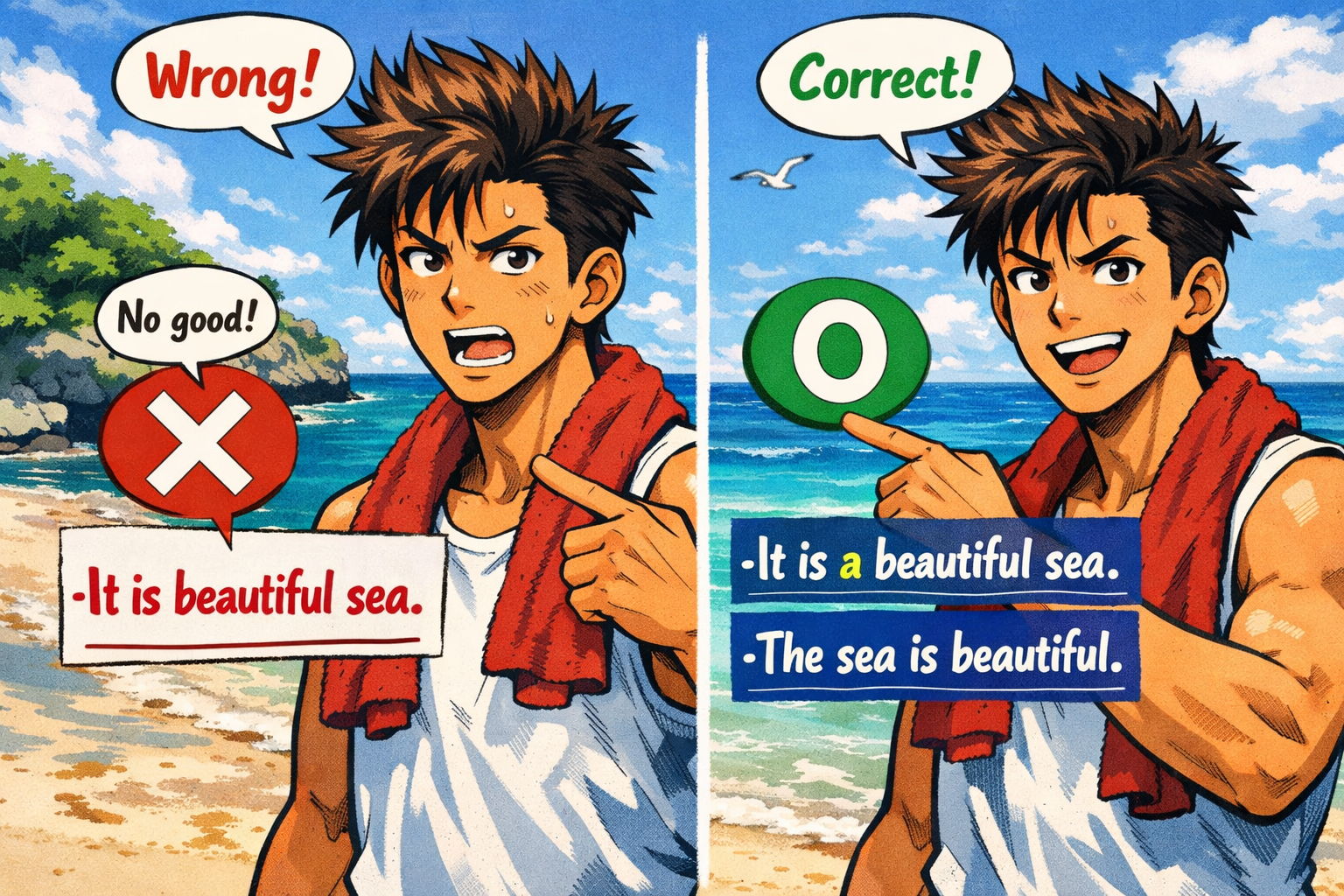
❌ It is beautiful sea.
❌ It is delicious cake.
❌ It is big dog.

Japanese students often feel these sentences are correct—and honestly, I understand why.

But in English, they sound very unnatural.

Let’s fix this problem once and for all.


🇯🇵 Why This Happens (Japanese Thinking vs English Thinking)

In Japanese, this sentence is perfectly normal:

きれいな海です。
(kirei na umi desu)

Structure:

adjective + noun + です

So students naturally try:

❌ It is beautiful sea.

But English does NOT work the same way.


The Rule: You Cannot Say "It is adjective + noun"

In English:

❌ It is beautiful sea. → Wrong
❌ It is delicious cake. → Wrong

Why?

Because beautiful sea is a noun phrase.
And noun phrases usually need a or the.


✔️ The Three Correct Ways

When Japanese students want to say:

きれいな海です

There are three natural English options:

✔️ Option 1: Use "a"

✔️ It is a beautiful sea.

Use this when you mean:

👉 One beautiful sea (general description)

Example:

  • It is a beautiful city.

  • She is a kind teacher.

  • This is a good restaurant.

✔️ Option 2: Use "the"

✔️ It is the beautiful sea.

This is less common and used when:

👉 We already know which sea you mean.

Example:

  • This is the beautiful beach we visited last year.


✔️ Option 3 (Most Natural): Change the Sentence

Very often, native speakers say:

✔️ The sea is beautiful.

This is usually the best and most natural sentence.

Compare:

❌ It is beautiful sea.
✔️ The sea is beautiful.

Much better.


A Simple Trick to Remember

If your sentence looks like:

❌ It is + adjective + noun

Stop.

Ask yourself:

👉 Do I need "a" or "the"?

Most of the time, the answer is:

✔️ YES


Common Mistakes Japanese Students Make

Here are some very common examples:

❌ It is beautiful sea.
✔️ It is a beautiful sea.
✔️ The sea is beautiful.

❌ It is delicious cake.
✔️ It is a delicious cake.
✔️ The cake is delicious.

❌ It is big dog.
✔️ It is a big dog.
✔️ The dog is big.


Why This Mistake Is So Common

Because Japanese allows:

adjective + noun + です

But English requires:

a/the + adjective + noun

This is a grammar difference between languages, not a mistake in thinking.


Teacher’s Advice (After 30+ Years of Teaching)

Here is what I tell my students:

👉 If you see "It is adjective noun," something is missing.

Usually:

✔️ Add a
OR
✔️ Change the sentence order

Practice this, and your English will sound much more natural.


Quick Practice (Try It!)

Fix these sentences:

  1. ❌ It is beautiful flower.

  2. ❌ It is interesting movie.

  3. ❌ It is good teacher.

Answers:

  1. ✔️ It is a beautiful flower.

  2. ✔️ It is an interesting movie.

  3. ✔️ He/She is a good teacher. (Better!)

Final Thought

Mistakes like "It is beautiful sea" are very common for Japanese learners.

But once you understand the rule:

👉 English nouns usually need "a" or "the"

—you will fix this problem quickly.

And your English will sound much more natural.
In Adjectives, Word Order, Common Mistakes in Englis Tags Common Mistakes, Adjectives, Adjective + Noun, 英会話, 英会話 福岡市中央区, 南天神英会話
Comment

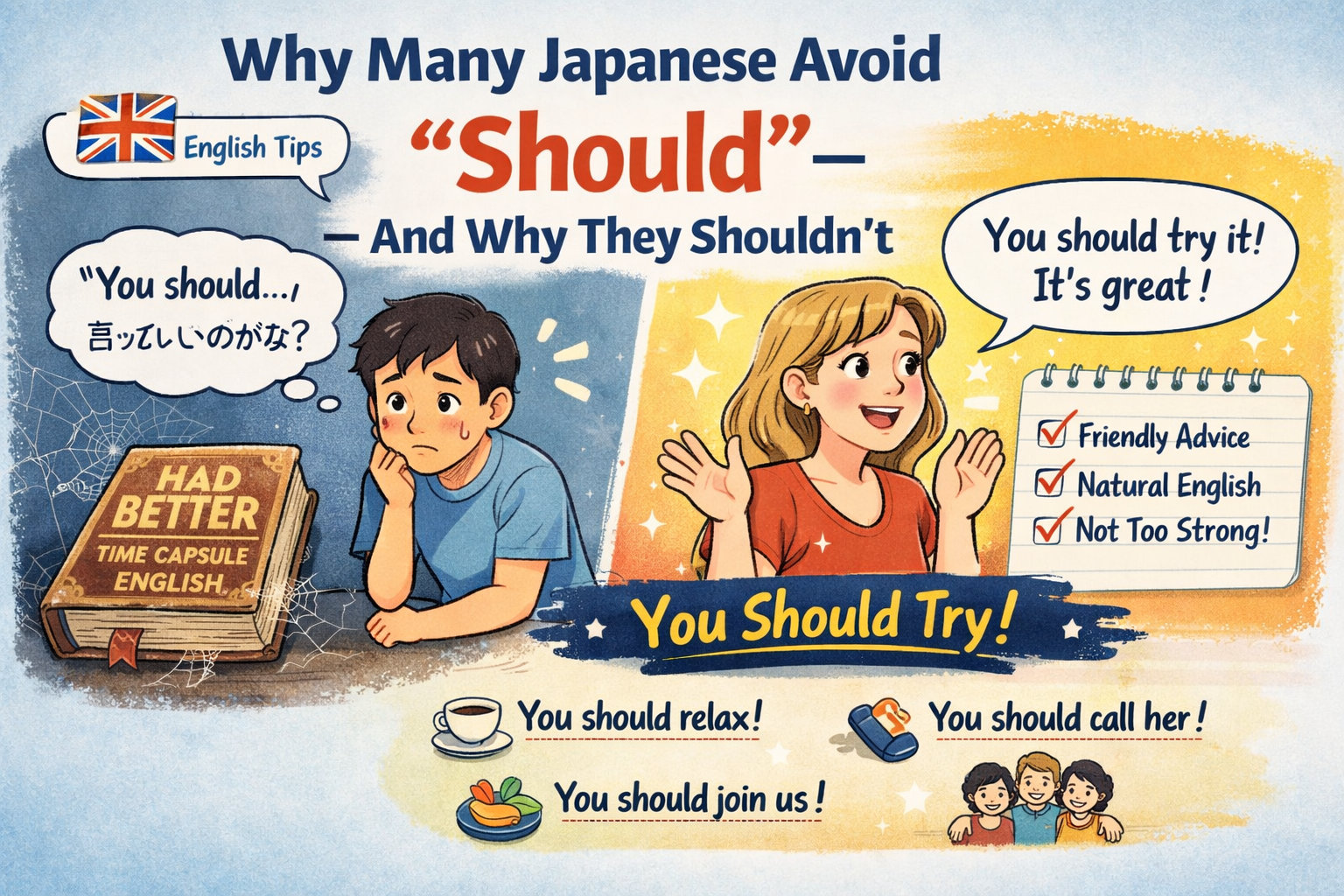
Why Many Japanese Avoid “Should” — And Why They Shouldn’t

March 28, 2026

Many Japanese learners of English hesitate to use the word should.

Why?

Because somewhere along the way, they learned that should = 〜すべき, and すべき sounds strong, strict, or even moral. So they worry:

"If I say 'You should…', will I sound bossy?"

The short answer?

No — not at all.

In modern English, should is one of the most common and natural ways to give advice.

The Real Meaning of “Should”

In everyday English, should usually means:

  • 〜したほうがいい

  • 〜するといいよ

  • 〜がおすすめ

For example:

  • You should try this restaurant.
    (このレストラン、行ってみたほうがいいよ。)

  • You should get some rest.
    (少し休んだほうがいいよ。)

  • You should watch this movie. It's great.
    (この映画、見たほうがいいよ。すごくいいよ。)

None of these sound strict or severe.

They sound friendly.

The Phrase You Learned… But Rarely Hear

Many Japanese learners were also taught this phrase:

had better

For example:

  • You had better study.

  • You had better go now.

But here’s the surprising truth:

Native speakers don’t use “had better” very often.

And when we do use it, it usually sounds strong — sometimes even like a warning.

Compare these:

  • You should leave now.
    (そろそろ出たほうがいいよ。)

  • You had better leave now.
    (今すぐ出ないと大変なことになるよ。)

See the difference?

“Had better” feels more serious.

This Is What I Call “Time Capsule English”

Some English expressions taught in textbooks were common decades ago — but are less common today.

They are like language trapped in a time capsule.

“Had better” is a good example.

It still exists — but it’s not something people use every day.

Meanwhile, should has remained very common and very natural.

What Native Speakers Actually Say Today

Here are some very common ways to give advice:

  • You should try it.

  • You might want to try it.

  • You could try it.

  • I'd recommend trying it.

Among these, should is probably the most useful and most natural for learners.

So Don’t Be Afraid to Use “Should”

If you remember only one thing from this post, remember this:

“Should” is friendly advice — not strict orders.

In fact, native speakers use should every day.

So the next time you want to give advice, don’t hesitate.

Just say:

  • You should try it.

  • You should get some rest.

  • You should join our class!

(Yes — that last one was intentional.)

In Everyday Phrases Tags Should 使い分け, 英会話, 英会話スクール, 英会話 福岡市中央区, 南天神英会話
Comment

Was Broken

August 31, 2023

“My notebook computer was broken,” my student told me.

This is another problem rooted in direct translation. 壊れた is in past passive tense so Japanese assume that it must be the same in English, but it’s not.

“My laptop was broken” actually means the opposite. It was broken, but is okay now, that is no longer broken.


❌ Something was broken.

⭕️ Something is broken.

⭕️ Something broke.

⭕️ Something doesn’t work.

⭕️ Something is out of order.


こわれる 【壊れる】 〖破壊される〗【ばらばらになる】break*, be broken ; 【部分的に壊れる】be damaged ; 【完全に壊れる】be destroyed ; 【めちゃくちゃになる】be wrecked (⇨壊す); 【ぼろぼろに崩れる】collapse, fall* apart ; 【機械などの調子が狂う】get* out of order ; 【故障する】break (down). ▸ 壊れたおもちゃ a broken toy.▸ 壊れ(やすい)物 (⇨壊れ物)▸ 花びんが床に落ちて壊れた The vase fell on the floor and broke (into [to] pieces). (!into [to] pieces では「粉々に」の意が出る) / The vase fell on the floor and smashed to pieces. (!前の言い方より強意的) ▸ 衝突で電車がめちゃめちゃに壊れたIn the collision the train was badly damaged [wascompletely wrecked]. (!後の方はまったく修理不可能なことを含意) ▸ この電話[コンピューター]は壊れている This telephone [PC] is out of order [is broken, doesn't work].▸ この洗濯機はまた壊れたThis washing machine has broken down again.▸ 縁談がこわれた The match [Their engagement] was broken (off).▸ 最後のところで商談がこわれた The deal collapsed [fell through] at the last moment.

In Verb, Participles Tags 壊れる in English, is broken vs was broken, 英会話, 英会話スクール, 英会話英会話
Comment
Be Rain.jpg

Be Rain

September 7, 2018

❌ It will be rain tomorrow. 

It’s going to rain tomorrow. 

It's going to be rainy tomorrow.

It will rain tomorrow.

We'll have rain tomorrow.


雨が/は

▸ 今ひどく雨が降っています 

It's raining hard [drizzling] now.

▸ しとしと雨が降っています 

It's raining hard [drizzling] now.

▸ あすは雨が降るだろう 

It will rain tomorrow.

We will have rain tomorrow. 

(話し手のいる場所について述べるときは It より We を主語にする方が多い) 

▸ 雨が降り出した

It started to rain.

The rain began [started] to fall. 

▸ 雨が降りやんだ 

The rain has stopped.

▸ 雨はやみそうになかった 

The rain showed no sign of letting up. 

▸ 今年はあまり雨が降らなかった 

We haven't had much rainfall this year.

▸ 今朝から雨が降ったりやんだりしている 

It has been raining on and off since this morning.

The rain has been coming and going since this morning.

▸ 雨がだんだん強くなってきた 

It's raining harder.

The rain is getting heavier.

▸ 家を出た時は雨がひどく降っていたが, 今は小降りになった 

It was raining hard when I left home, but now it has let up.

▸ 曇り時々雨 (天気予報で) 

Cloudy with occasional showers.

In Nature Tags Rain, Weather, 英会話, 英語の天気予報
Comment
While in Portland I met a good buddy (friend) from college. We hadn't seen each other in about 20 years. He hadn't changed a bit.

While in Portland I met a good buddy (friend) from college. We hadn't seen each other in about 20 years. He hadn't changed a bit.

After a long time

September 5, 2018

△ We met after a long time.

→ We met for the first time in a long time.


△ I went to a beer garden after a long time.

→ I went to a beer garden for the first time in a long time.


久しぶり


for the first time in a long time

for the first time in ages

for the first time in many years


((1) after a long time ともいう. (2) ⦅書⦆ では「長い時の経過[留守; 音信不通; 別離]の後で」の意で after a long interval [absence; silence; separation] などを用いることもある )

▸ 彼女から久しぶりに電話があった

I had a call from her for the first time in a long time [in many years].⦅書⦆I had a call from her after a long silence.


▸ あんなに魅力のある人に会ったのは久しぶりだ

It's [It's been] a long time since I met such a charming person.


▸ 久しぶりに最高のニュースを聞いたよ

That's the best news I've heard for a long time.


▸ 久しぶりですね

I haven't seen you for a long time

I haven't seen you for ages

It's been ages!


(It's) good to see you again.

(!最後の言い方は仕事上などの改まった場合に用いる.「お久しぶり」に続く表現としては How have you been? (どうしてたの)や I could hardly recognize you. (誰だか分からなかった)などがある)


―振り


1 【…の後】

after …;〖…以来〗since …;〖…の期間で初めて〗for the first time in 〘ten years〙.


▸ 私は8年ぶりで彼に会った

I saw him for the first time in eight years.I saw him after (an [╳the] interval of) eight years [after an eight-year interval]. (!after eight years' interval とはあまりいわない) 【この前会ってから8年になる】It's [It's been] eight years since I saw him last. (!最初の表現がいちばん口語的)


▸ 登山者は5日ぶりに[遭難後5日ぶりに]救出された

The climbers were rescued after five days [five days after the mountain accident].


▸ 今年は20年ぶりの暖冬です

This is the warmest winter in ⦅主に米⦆ [for ⦅主に英⦆] 20 years.This is the warmest winter (that) we have had in () [for ⦅主に英⦆] the past [last] twenty years.


▸ こんなくつろいだ気分になるのは何年ぶりかです

I feel more relaxed than I've felt in ⦅主に米⦆ [for ⦅主に英⦆] years. (!than 以下に否定が含意された言い方で, I haven't felt as relaxed in [for] years (as this). (as this は通例省略する)に相当する )

In Adverbs Tags ーぶりに, 久しぶりに, for the first time in a long time, 英会話, 英会話スクール, 福岡市英語, 福岡英語教室
Comment
No results found

Instagram

Back at Sri Lanka Nishijin today. Never gets old.
Curry Tiner’s South Indian Chicken & Mutton Curry

I have been following the guy for years on Instagram and have been meaning to go, but the planets never quite seemed to line up. Today they did and thank God for that.

Wow!

Expect a long
Ippodo Tea Shop, Kyōto
Higashi Hongan-ji, Kyōto
All ready for Thanksgiving.

#shochu #imojochu #焼酎 #いも焼酎
Display Cases of Kyoto
Inukaeshi in Kyōto 

京都の犬返し

#Kyoto #Inukaeshi #犬返し #京都 #Machiya #町屋
Walls in Gokusho Machi, Hakata
The 15th of August is the last day of the Bon Festival of the Dead, Japan’s version of Dia de muertos. On this day, Japanese say goodbye to the spirits of their ancestors. Today I say goodbye to my last drop of Yamato Zakura Beni Imo 35%. Forgi
Azaleas at Fukuoka’s Kushida Shrine 

#櫛田神社 #Kushida #springinjapan #Fukuoka
Mugon (Tacit, lit. Without Words) rice shōchū genshu from Sengetsu Distillery of Hitoyoshi, Kumamoto. Aged in cypress casks, I believe, it retains that telltale hinoki scent. I normally don’t drink Kuma-jōchū, but this is lovely. I’ll buy
Another one of my somewhat hard-to-find favorites. Sang Som from Thailand. So smooth. I used to keep a bottle of it at Gamaradi before the pandemic. May have to do so again. Missed it. Missed Mr. Chang.
ブログ RSS
Unknown.jpeg
Featured
4c0a6231-58c1-450e-8f3a-bf718f86ea48.png
September 10, 2026
Win or Beat?
September 10, 2026
Read more →
September 10, 2026
Posessive Pronouns.png
September 2, 2026
Possessive Pronouns
September 2, 2026
Read more →
September 2, 2026
79a452f9-f4a0-4760-886d-544c736d0118.png
April 9, 2026
❌ "It is beautiful sea." — Why This Sentence Sounds Strange in English
April 9, 2026
Read more →
April 9, 2026
Avoiding Should.png
March 28, 2026
Why Many Japanese Avoid “Should” — And Why They Shouldn’t
March 28, 2026
Read more →
March 28, 2026
cde4019a-29a3-48cd-aa3c-880d433105fc.png
March 7, 2026
Why English Teachers Secretly Panic When Students Say “Good Taste!”
March 7, 2026
Read more →
March 7, 2026
c31b89c7-2fdd-441e-87ff-6af1ad634b1d.png
May 9, 2025
Admit vs Accept
May 9, 2025
Read more →
May 9, 2025
Die Of:From:In.png
April 12, 2025
Die Of/From/In
April 12, 2025
Read more →
April 12, 2025
Pan Ya Ya.jpg
November 19, 2024
Pan Ya Ya
November 19, 2024
Read more →
November 19, 2024
Shohei English.jpg
November 18, 2024
Shohei's English
November 18, 2024
Read more →
November 18, 2024
Screenshot 2024-03-12 at 4.30.42.png
March 13, 2024
By My Car
March 13, 2024
Read more →
March 13, 2024
Blog Photo.jpeg
Featured
What about:How about (kuroko).png
September 17, 2026
What About…? vs. How About…?
September 17, 2026
Read more →
September 17, 2026
Blog - Stuff.png
September 16, 2026
The Most Important English Word You Were Never Taught: “Stuff”
September 16, 2026
Read more →
September 16, 2026
American Cursive.png
September 14, 2026
Cursive Writing
September 14, 2026
Read more →
September 14, 2026
426b7067-f48b-47be-8112-182c79de9fa4.png
September 9, 2026
Why English Speakers Say “Twenty Twenty-Six”
September 9, 2026
Read more →
September 9, 2026
Malay Duplication.png
August 29, 2026
Reduplication in Languages
August 29, 2026
Read more →
August 29, 2026
c037c2d6-ac46-420e-abba-47c9bd494cc8.png
August 21, 2026
Katakana Does Not Always Mean English!
August 21, 2026
Read more →
August 21, 2026
Sentence Building Blocks.png
May 17, 2026
Sentence Building Blocks
May 17, 2026
Read more →
May 17, 2026
Why do Fukuoka Schools Celebrate in May.png
May 16, 2026
The May Miracle: Why Fukuoka’s Schools Are All Celebrating Right Now
May 16, 2026
Read more →
May 16, 2026
BC05DF4D-5356-4E91-8CCB-A3F1CDE4C5F2.png
May 10, 2026
15 Things Serious English Students Actually Do
May 10, 2026
Read more →
May 10, 2026
a_colorful_infographic_poster_bright_cartoon_illu.png
April 19, 2026
How Many English Words Do You Know?
April 19, 2026
Read more →
April 19, 2026
word-of-the-day-new.jpg
Featured
couple-2585328_640.jpg
May 23, 2018
In Ages
May 23, 2018
Read more →
May 23, 2018
50e524604a672a893aacf7eead6bc3c5.jpg.gif
May 19, 2018
Wishy-Washy
May 19, 2018
Read more →
May 19, 2018
600px-CousinTree.svg.png
May 19, 2018
Once Removed
May 19, 2018
Read more →
May 19, 2018
93979218f3c25c57a03295c14a6715b7.jpg
May 18, 2018
Assertive vs Aggressive
May 18, 2018
Read more →
May 18, 2018
Resources.jpg
Featured
pe240215.gif
February 29, 2024
Peanuts
February 29, 2024
Read more →
February 29, 2024
Screenshot 2024-02-06 at 4.41.13.png
February 6, 2024
OWAD's Word a Day
February 6, 2024
Read more →
February 6, 2024
January 27, 2021
Beginning, Middle, End
January 27, 2021
Read more →
January 27, 2021
nn_kids_thumbnail_02_154678_f81e2f6d0d7589ff5cda5a641cfb8c23.jpg
December 25, 2020
Nightly News: Kids Edition
December 25, 2020
Read more →
December 25, 2020
history_of_english4.png
September 8, 2020
History of the English Language
September 8, 2020
Read more →
September 8, 2020
nursery-rhymes.jpg
September 3, 2020
Mother Goose
September 3, 2020
Read more →
September 3, 2020
crossword puzzle.png
April 10, 2019
Crossword Puzzles
April 10, 2019
Read more →
April 10, 2019
maxresdefault.jpg
March 25, 2019
Student Recommendations
March 25, 2019
Read more →
March 25, 2019
How to Improve Your English.jpg
February 22, 2019
How to Improve Your English
February 22, 2019
Read more →
February 22, 2019
November 22, 2018
Eigo Beat
November 22, 2018
Read more →
November 22, 2018