• Home
  • 授業料・クラス一覧
  • レッスン内容
  • 今月の休み
  • プロフィール
  • 生徒さんの声
  • 翻訳・編集
  • ブログ
  • Word
  • Resources
  • Mistakes
  • Contact

スピーク英会話サロン【福岡】

  • Home
  • 授業料・クラス一覧
  • レッスン内容
  • 今月の休み
  • プロフィール
  • 生徒さんの声
  • 翻訳・編集
  • ブログ
  • Word
  • Resources
  • Mistakes
  • Contact
  • Menu

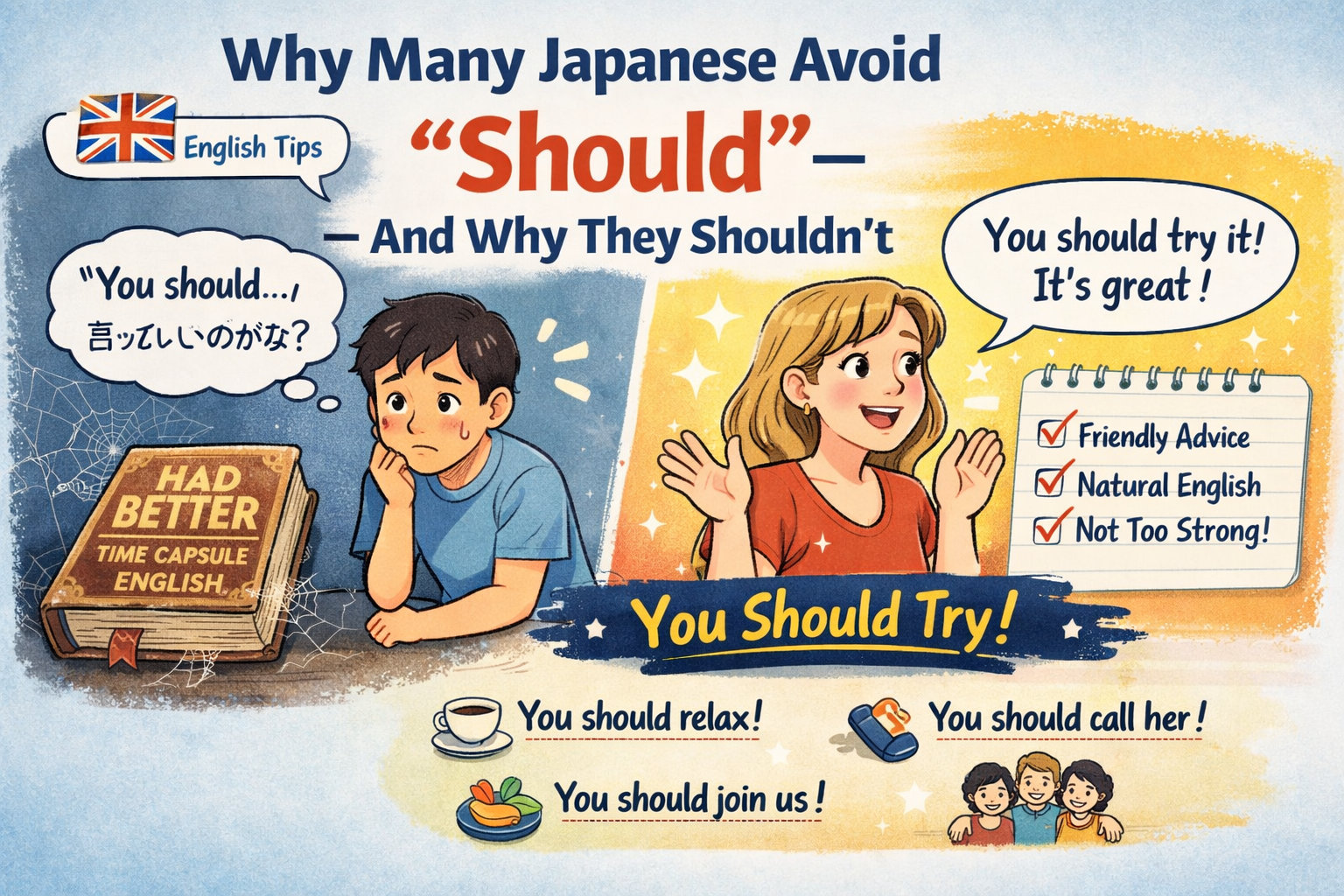
Why Many Japanese Avoid “Should” — And Why They Shouldn’t

March 28, 2026

Many Japanese learners of English hesitate to use the word should.

Why?

Because somewhere along the way, they learned that should = 〜すべき, and すべき sounds strong, strict, or even moral. So they worry:

"If I say 'You should…', will I sound bossy?"

The short answer?

No — not at all.

In modern English, should is one of the most common and natural ways to give advice.

The Real Meaning of “Should”

In everyday English, should usually means:

  • 〜したほうがいい

  • 〜するといいよ

  • 〜がおすすめ

For example:

  • You should try this restaurant.
    (このレストラン、行ってみたほうがいいよ。)

  • You should get some rest.
    (少し休んだほうがいいよ。)

  • You should watch this movie. It's great.
    (この映画、見たほうがいいよ。すごくいいよ。)

None of these sound strict or severe.

They sound friendly.

The Phrase You Learned… But Rarely Hear

Many Japanese learners were also taught this phrase:

had better

For example:

  • You had better study.

  • You had better go now.

But here’s the surprising truth:

Native speakers don’t use “had better” very often.

And when we do use it, it usually sounds strong — sometimes even like a warning.

Compare these:

  • You should leave now.
    (そろそろ出たほうがいいよ。)

  • You had better leave now.
    (今すぐ出ないと大変なことになるよ。)

See the difference?

“Had better” feels more serious.

This Is What I Call “Time Capsule English”

Some English expressions taught in textbooks were common decades ago — but are less common today.

They are like language trapped in a time capsule.

“Had better” is a good example.

It still exists — but it’s not something people use every day.

Meanwhile, should has remained very common and very natural.

What Native Speakers Actually Say Today

Here are some very common ways to give advice:

  • You should try it.

  • You might want to try it.

  • You could try it.

  • I'd recommend trying it.

Among these, should is probably the most useful and most natural for learners.

So Don’t Be Afraid to Use “Should”

If you remember only one thing from this post, remember this:

“Should” is friendly advice — not strict orders.

In fact, native speakers use should every day.

So the next time you want to give advice, don’t hesitate.

Just say:

  • You should try it.

  • You should get some rest.

  • You should join our class!

(Yes — that last one was intentional.)

In Everyday Phrases Tags Should 使い分け, 英会話, 英会話スクール, 英会話 福岡市中央区, 南天神英会話
Comment

C.M. with Time

February 27, 2024

a.m., A.M. 2AM 2, am 2⦅英⦆ | èɪém |

〖<ラテン; ante meridiem (before noon)〗 副詞

午前 (↔ p.m., P.M., PM) (!数字の後に置き, 通例時刻表など以外は小文字; o'clockは付けない)

▸ at 9 a.m. [╳a.m. 9] 午前9時に

▸ the 8 a.m. train to Tokyo 東京行き午前8時の列車.

午後 (↔ a.m., A.M., AM) (!数字の後に置き, 通例時刻表など以外は小文字; o'clockは付けない)

▸ at 6:30 p.m. 午後6時半に (!at six-thirty p.m.と読む) .

―じ 【―時】 o'clock. (!(1) of the clock の省略形. (2) 分までいう場合や a.m. (午前), p.m. (午後)とともには用いない: ╳6 o'clock p.m. (3) o'clock の前では数字より six などと書く方が普通) (⇨分 , ⇨何時)

▸ 2時ちょうどに at two (o'clock) sharp / at just two (o'clock).

▸ 午後6時頃に 【at】around [about] 6 p.m. (晩の6時頃に)【at】around [about] six (o'clock) in the evening. (!18時のようにいうときは 1800 hours と書き eighteen hundred [⦅やや話⦆ nothing] hours と読む)

▸ 9時[9時1分]の列車に乗る take the nine o'clock [9:01] train. (!前の方は 9:00 [⦅英⦆ 9.00]とも書き nine o'clock と読む. 後の方は nine-o | oʊ | -one と読む. 文脈から明らかな場合, train は省略可)

▸ 私たちは午前10時に駅で会うことになっている We are to meet at the station at ten (o'clock) in the morning.

In Everyday Phrases Tags How to tell time in English, Telling Time in English, 英語で時間
Comment

Common Mistake with I'm Sorry

February 21, 2024

🔺 (I'm) sorry to be late は可能だが⦅まれ! & 不自然!⦆

▸ (I'm) sorry for/about being late yesterday.

. . . we’re lateが続くときは, Sorry we're late. のようにsorryの前の主語と〖動詞〗は省略されるのが普通)

But . . .

▸ (I'm) sorry to bother [trouble] you, but I've got to talk to you.

ご面倒をおかけして申し訳ないのですが, お話があるのです (文脈から明らかな場合, butまで述べた時点で聞き手がそれ以降を察することも多い)

お待たせして申し訳ありません

▸ I'm sorry to have kept you waiting. ⦅かたく⦆

▸ I'm sorry for having kept you waiting.⦅まれ⦆

3 比較なし 〖be ~〗 残念に思って(regretful); «…することを/…ということを» 残念に思う «to do/(that)節» (!⦅かたく⦆ ではI regret …)

▸ (I'm) sorry to hear that.

(悪い知らせなどを聞き)それは残念です

In Everyday Phrases, Idiomatic Phrases Tags 「I'm sorry to be late」はNG
Comment

Common Mistake with Movies

February 19, 2024

えいが 【映画】

⦅主に米⦆ a movie, ⦅書⦆ a motion picture, ⦅主に英⦆ a film (!⦅米⦆ でも新聞などでは普通) ; ⦅集合的⦆ ⦅主に米⦆ the movies, ⦅主に英⦆ the cinema [╳cinemas], the pictures (!the cinema の古風な言い方) .

~映画

▸ ギャング[アクション; 恐怖; 戦争; 無声]映画 a gangster [an action; a horror; a war; a silent] movie.

▸ 記録映画 a documentary (film).▸ 2本立て映画 a double feature (program).

▸ モンロー主演の映画 a movie starring Monroe.

▸ テレビ用映画 a TV movie / a made-for-TV movie.

▸ 新着映画 a newly released movie [film].


会話

▸ 「すばらしい映画でしたね」「ええ, そうでしたね」 “It was a great movie.” “Yes, I thought so too.”


映画が[は]

▸ 私は映画が好きです I like [love] watching movies. / I like [am fond of] movies.

▸ この映画は最近封切られたThis movie was recently released. (⇨封切り)

▸ その映画おもしろかった? Did you enjoy the movie? 【どうだった?】How was the movie?

▸ テレビが発達して映画は衰退した Movies declined when television was developed.

映画に[で]

▸ 映画で主役を演じる star in a movie.

▸ 彼はタクシーの運転手としてその映画に出ている He appears as [plays] a cabdriver in the movie. (!後の方が普通)

▸ 彼はその小説を映画に⦅映画化⦆した He made [turned] the novel into a movie [a film]. / He filmed the novel. (!映画化したものは a movie [a film] version of the novel という)


映画を

▸ 映画を見る see [watch] a movie [a film]. (!今映画を見ているときは watch を用いる)

▸ 映画を上映するshow [present] a movie.

▸ 映画を撮る[封切る] shoot [release] a movie [a film].

▸ 映画を製作する produce [make] a movie [a film].

▸ 彼の最新の映画を見ましたか Have you seen his latest movie?

▸ 今夜映画を見に行こう Let's go to the movies [a movie, ⦅英⦆ the cinema] tonight. (!(1) go to see [╳watch] a movie [a film] ともいえる. ╳go to see the movies [cinema] とはいわない. (2) go to the movie は「特定の映画を見に行く」の意)


映画音楽 movie [film] music.映画界 the movie [motion picture, film] world / the movies [films, ⦅英⦆ cinema].映画館 ⦅米⦆ a movie theater, a movie house ⦅英⦆ a cinema.映画鑑賞 【一般的な】movie viewing 【学科の】cinema appreciation, appreciation of the cinema.映画狂 a movie [a film] addict.映画祭 a movie [a film] festival.映画撮影所 a (movie) studio.映画産業 the movie [film] industry.映画女優 a movie [a film, a screen] actress.映画スター a movie [a film] star.映画製作 ⦅米⦆ moviemaking ⦅英⦆ filmmaking. (!製作者は a movie [film] maker. a producer は製作上の経済的責任を負う. 監督は a director) 映画俳優 a movie [a film, a screen] actor.映画評論家 a movie [a film] critic.映画ファン a movie fan ⦅主に米⦆ a moviegoer ⦅主に英⦆ a filmgoer, a cinemagoer.

In Everyday Phrases Tags movies, movie, ださい英語
Comment

Common Mistake: Tomorrow will be . . .

December 21, 2023


❌ Tomorrow will be snow.

It’s going to snow tomorrow.
It might snow tomorrow.

It’s going to be snowy tomorrow.
It’s going to be rainy tomorrow.
It’s going to be cloudy tomorrow.
It’s going to be sunny tomorrow.

It’s going to be hot tomorrow.
It’s going to be really cold tomorrow.


△ Tomorrow will be snowy. (ちょっと不自然)

In Everyday Phrases, Word Order Tags 明日の天気
Comment

Catch Cold

February 7, 2022

Now that winter has settled in, colds will start going around (風邪がはやる) and students of English will once again be incorrectly using the phrase they memorized in junior high school “catch cold” (風邪を引く). Like some English verbs—such as get dressed/wear—catching a cold is not just one on/off action, but rather a progression of actions or process.

I think I’m coming down with a cold.

↓

I’m coming down with a cold.

↓

I’ve caught a cold.

↓

I have a slight cold.

↓

I have a cold. (now)

↓

I have a bad cold. 

↓

I’ve had a cold since yesterday.

↓

My cold is getting better.

↓

I’m all better. 

I’ve gotten over my cold.

風邪

【普通の風邪】(a) cold ; 【インフルエンザ】influenza, ⦅話⦆ (the) flu. ~風邪▸ せきの出る[鼻]風邪 〘have〙 a cold in [on] the chest [in the head] / a chest [a head] cold.

▸ 夏風邪 a summer cold.

▸ ひどい[軽い; しつこい]風邪 a bad [a slight; a stubborn] cold. 風邪~

▸ 風邪気味である have a slight [a touch of a] cold. 風邪が[は]

▸ 風邪は万病のもと (⇨万病)

▸ 風邪が学校ではやっている【The】flu is [Colds are] going around in our school.

▸ 彼の風邪がうつった I got a cold [caught (a) cold] from him. / He gave me his cold [╳his cold to me].

▸ ちっとも風邪が治らない I just can't get over [(取り除く) get rid of, (振り払う) shake off] my cold.

▸ 風邪はだいぶよくなりました[ひどくなってきました] My cold is much better now [is getting worse].

▸ 患者は快方に向かっているようだったが, 突然風邪がぶりかえした The patient seemed to be recovering from his cold, but suddenly he suffered [had] a relapse. 風邪を[で]

▸ 風邪を引いている have a cold / be sick [⦅英⦆ ill] with a cold.

▸ 風邪を引きかけている be getting [coming down with] a cold.

▸ 風邪を引きやすい catch (a) cold easily / be subject [susceptible] to colds.

▸ 風邪を引いて熱がある have a fever with a cold.

▸ 風邪をこじらせる make one's cold worse.

▸ 風邪を引かないように気をつけなさい Take care [Be careful] not to catch (a) cold.

▸ ちょっと風邪を引いちゃった I've got a bit of a cold.

▸ 彼は今日は風邪を引いて寝ている He is in bed with a cold today.

▸ 風邪で胃(の調子)が変になっている My cold is affecting my stomach. 風邪薬 〘take〙 medicine for a cold / a cold medicine [(錠剤) pill].

In Idiomatic Phrases, Everyday Phrases Tags 風邪をひく, catch a cold
Comment
No results found

Instagram

Back at Sri Lanka Nishijin today. Never gets old.
Curry Tiner’s South Indian Chicken & Mutton Curry

I have been following the guy for years on Instagram and have been meaning to go, but the planets never quite seemed to line up. Today they did and thank God for that.

Wow!

Expect a long
Ippodo Tea Shop, Kyōto
Higashi Hongan-ji, Kyōto
All ready for Thanksgiving.

#shochu #imojochu #焼酎 #いも焼酎
Display Cases of Kyoto
Inukaeshi in Kyōto 

京都の犬返し

#Kyoto #Inukaeshi #犬返し #京都 #Machiya #町屋
Walls in Gokusho Machi, Hakata
The 15th of August is the last day of the Bon Festival of the Dead, Japan’s version of Dia de muertos. On this day, Japanese say goodbye to the spirits of their ancestors. Today I say goodbye to my last drop of Yamato Zakura Beni Imo 35%. Forgi
Azaleas at Fukuoka’s Kushida Shrine 

#櫛田神社 #Kushida #springinjapan #Fukuoka
Mugon (Tacit, lit. Without Words) rice shōchū genshu from Sengetsu Distillery of Hitoyoshi, Kumamoto. Aged in cypress casks, I believe, it retains that telltale hinoki scent. I normally don’t drink Kuma-jōchū, but this is lovely. I’ll buy
Another one of my somewhat hard-to-find favorites. Sang Som from Thailand. So smooth. I used to keep a bottle of it at Gamaradi before the pandemic. May have to do so again. Missed it. Missed Mr. Chang.
ブログ RSS
Unknown.jpeg
Featured
4c0a6231-58c1-450e-8f3a-bf718f86ea48.png
September 10, 2026
Win or Beat?
September 10, 2026
Read more →
September 10, 2026
Posessive Pronouns.png
September 2, 2026
Possessive Pronouns
September 2, 2026
Read more →
September 2, 2026
79a452f9-f4a0-4760-886d-544c736d0118.png
April 9, 2026
❌ "It is beautiful sea." — Why This Sentence Sounds Strange in English
April 9, 2026
Read more →
April 9, 2026
Avoiding Should.png
March 28, 2026
Why Many Japanese Avoid “Should” — And Why They Shouldn’t
March 28, 2026
Read more →
March 28, 2026
cde4019a-29a3-48cd-aa3c-880d433105fc.png
March 7, 2026
Why English Teachers Secretly Panic When Students Say “Good Taste!”
March 7, 2026
Read more →
March 7, 2026
c31b89c7-2fdd-441e-87ff-6af1ad634b1d.png
May 9, 2025
Admit vs Accept
May 9, 2025
Read more →
May 9, 2025
Die Of:From:In.png
April 12, 2025
Die Of/From/In
April 12, 2025
Read more →
April 12, 2025
Pan Ya Ya.jpg
November 19, 2024
Pan Ya Ya
November 19, 2024
Read more →
November 19, 2024
Shohei English.jpg
November 18, 2024
Shohei's English
November 18, 2024
Read more →
November 18, 2024
Screenshot 2024-03-12 at 4.30.42.png
March 13, 2024
By My Car
March 13, 2024
Read more →
March 13, 2024
Blog Photo.jpeg
Featured
What about:How about (kuroko).png
September 17, 2026
What About…? vs. How About…?
September 17, 2026
Read more →
September 17, 2026
Blog - Stuff.png
September 16, 2026
The Most Important English Word You Were Never Taught: “Stuff”
September 16, 2026
Read more →
September 16, 2026
American Cursive.png
September 14, 2026
Cursive Writing
September 14, 2026
Read more →
September 14, 2026
426b7067-f48b-47be-8112-182c79de9fa4.png
September 9, 2026
Why English Speakers Say “Twenty Twenty-Six”
September 9, 2026
Read more →
September 9, 2026
Malay Duplication.png
August 29, 2026
Reduplication in Languages
August 29, 2026
Read more →
August 29, 2026
c037c2d6-ac46-420e-abba-47c9bd494cc8.png
August 21, 2026
Katakana Does Not Always Mean English!
August 21, 2026
Read more →
August 21, 2026
Sentence Building Blocks.png
May 17, 2026
Sentence Building Blocks
May 17, 2026
Read more →
May 17, 2026
Why do Fukuoka Schools Celebrate in May.png
May 16, 2026
The May Miracle: Why Fukuoka’s Schools Are All Celebrating Right Now
May 16, 2026
Read more →
May 16, 2026
BC05DF4D-5356-4E91-8CCB-A3F1CDE4C5F2.png
May 10, 2026
15 Things Serious English Students Actually Do
May 10, 2026
Read more →
May 10, 2026
a_colorful_infographic_poster_bright_cartoon_illu.png
April 19, 2026
How Many English Words Do You Know?
April 19, 2026
Read more →
April 19, 2026
word-of-the-day-new.jpg
Featured
couple-2585328_640.jpg
May 23, 2018
In Ages
May 23, 2018
Read more →
May 23, 2018
50e524604a672a893aacf7eead6bc3c5.jpg.gif
May 19, 2018
Wishy-Washy
May 19, 2018
Read more →
May 19, 2018
600px-CousinTree.svg.png
May 19, 2018
Once Removed
May 19, 2018
Read more →
May 19, 2018
93979218f3c25c57a03295c14a6715b7.jpg
May 18, 2018
Assertive vs Aggressive
May 18, 2018
Read more →
May 18, 2018
Resources.jpg
Featured
pe240215.gif
February 29, 2024
Peanuts
February 29, 2024
Read more →
February 29, 2024
Screenshot 2024-02-06 at 4.41.13.png
February 6, 2024
OWAD's Word a Day
February 6, 2024
Read more →
February 6, 2024
January 27, 2021
Beginning, Middle, End
January 27, 2021
Read more →
January 27, 2021
nn_kids_thumbnail_02_154678_f81e2f6d0d7589ff5cda5a641cfb8c23.jpg
December 25, 2020
Nightly News: Kids Edition
December 25, 2020
Read more →
December 25, 2020
history_of_english4.png
September 8, 2020
History of the English Language
September 8, 2020
Read more →
September 8, 2020
nursery-rhymes.jpg
September 3, 2020
Mother Goose
September 3, 2020
Read more →
September 3, 2020
crossword puzzle.png
April 10, 2019
Crossword Puzzles
April 10, 2019
Read more →
April 10, 2019
maxresdefault.jpg
March 25, 2019
Student Recommendations
March 25, 2019
Read more →
March 25, 2019
How to Improve Your English.jpg
February 22, 2019
How to Improve Your English
February 22, 2019
Read more →
February 22, 2019
November 22, 2018
Eigo Beat
November 22, 2018
Read more →
November 22, 2018