• Home
  • 授業料・クラス一覧
  • レッスン内容
  • 今月の休み
  • プロフィール
  • 生徒さんの声
  • 翻訳・編集
  • ブログ
  • Word
  • Resources
  • Mistakes
  • Contact

スピーク英会話サロン【福岡】

  • Home
  • 授業料・クラス一覧
  • レッスン内容
  • 今月の休み
  • プロフィール
  • 生徒さんの声
  • 翻訳・編集
  • ブログ
  • Word
  • Resources
  • Mistakes
  • Contact
  • Menu

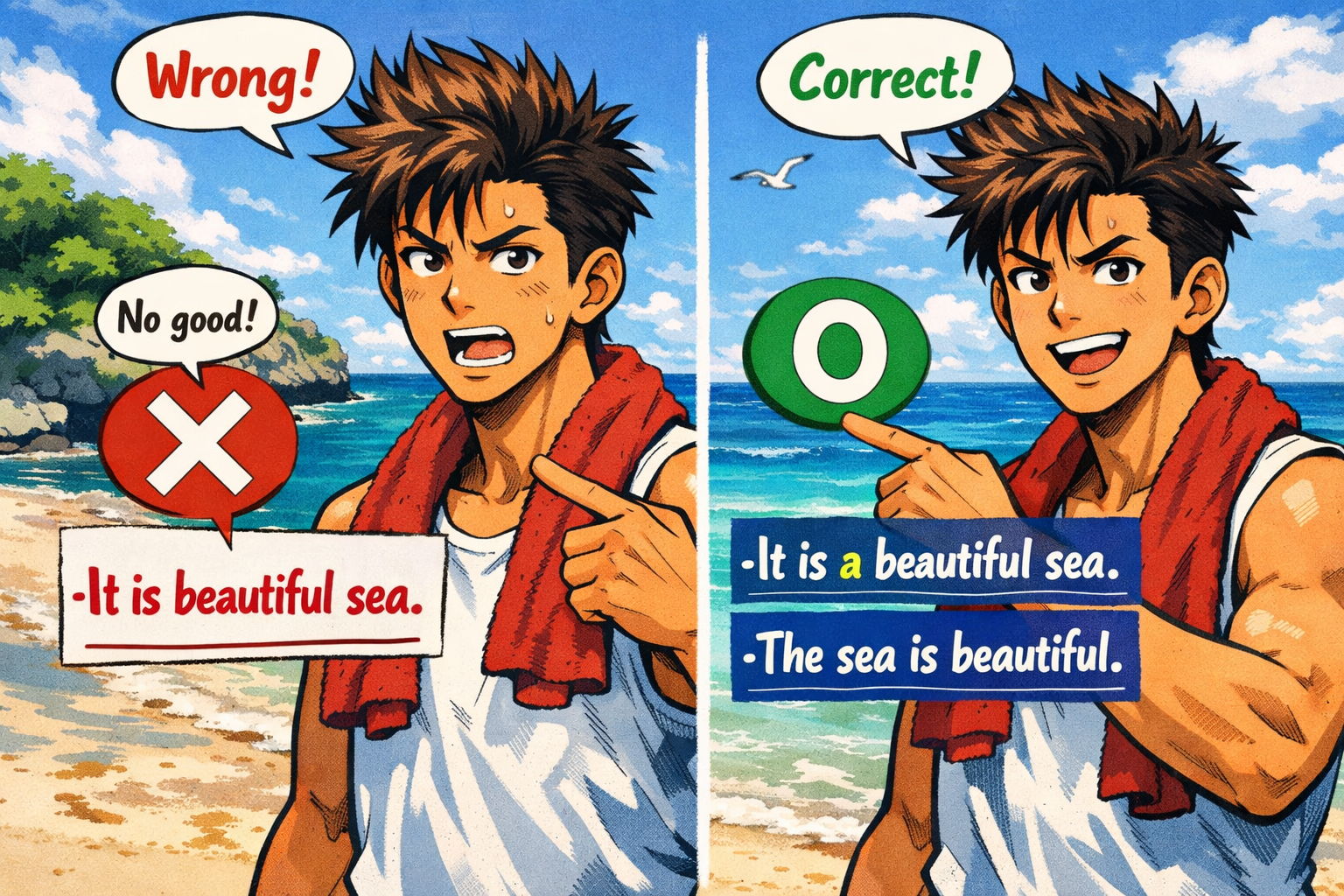
❌ "It is beautiful sea." — Why This Sentence Sounds Strange in English

April 9, 2026

Many Japanese learners of English make sentences like this:

❌ It is beautiful sea.
❌ It is delicious cake.
❌ It is big dog.

Japanese students often feel these sentences are correct—and honestly, I understand why.

But in English, they sound very unnatural.

Let’s fix this problem once and for all.


🇯🇵 Why This Happens (Japanese Thinking vs English Thinking)

In Japanese, this sentence is perfectly normal:

きれいな海です。
(kirei na umi desu)

Structure:

adjective + noun + です

So students naturally try:

❌ It is beautiful sea.

But English does NOT work the same way.


The Rule: You Cannot Say "It is adjective + noun"

In English:

❌ It is beautiful sea. → Wrong
❌ It is delicious cake. → Wrong

Why?

Because beautiful sea is a noun phrase.
And noun phrases usually need a or the.


✔️ The Three Correct Ways

When Japanese students want to say:

きれいな海です

There are three natural English options:

✔️ Option 1: Use "a"

✔️ It is a beautiful sea.

Use this when you mean:

👉 One beautiful sea (general description)

Example:

  • It is a beautiful city.

  • She is a kind teacher.

  • This is a good restaurant.

✔️ Option 2: Use "the"

✔️ It is the beautiful sea.

This is less common and used when:

👉 We already know which sea you mean.

Example:

  • This is the beautiful beach we visited last year.


✔️ Option 3 (Most Natural): Change the Sentence

Very often, native speakers say:

✔️ The sea is beautiful.

This is usually the best and most natural sentence.

Compare:

❌ It is beautiful sea.
✔️ The sea is beautiful.

Much better.


A Simple Trick to Remember

If your sentence looks like:

❌ It is + adjective + noun

Stop.

Ask yourself:

👉 Do I need "a" or "the"?

Most of the time, the answer is:

✔️ YES


Common Mistakes Japanese Students Make

Here are some very common examples:

❌ It is beautiful sea.
✔️ It is a beautiful sea.
✔️ The sea is beautiful.

❌ It is delicious cake.
✔️ It is a delicious cake.
✔️ The cake is delicious.

❌ It is big dog.
✔️ It is a big dog.
✔️ The dog is big.


Why This Mistake Is So Common

Because Japanese allows:

adjective + noun + です

But English requires:

a/the + adjective + noun

This is a grammar difference between languages, not a mistake in thinking.


Teacher’s Advice (After 30+ Years of Teaching)

Here is what I tell my students:

👉 If you see "It is adjective noun," something is missing.

Usually:

✔️ Add a
OR
✔️ Change the sentence order

Practice this, and your English will sound much more natural.


Quick Practice (Try It!)

Fix these sentences:

  1. ❌ It is beautiful flower.

  2. ❌ It is interesting movie.

  3. ❌ It is good teacher.

Answers:

  1. ✔️ It is a beautiful flower.

  2. ✔️ It is an interesting movie.

  3. ✔️ He/She is a good teacher. (Better!)

Final Thought

Mistakes like "It is beautiful sea" are very common for Japanese learners.

But once you understand the rule:

👉 English nouns usually need "a" or "the"

—you will fix this problem quickly.

And your English will sound much more natural.
In Adjectives, Word Order, Common Mistakes in Englis Tags Common Mistakes, Adjectives, Adjective + Noun, 英会話, 英会話 福岡市中央区, 南天神英会話
Comment

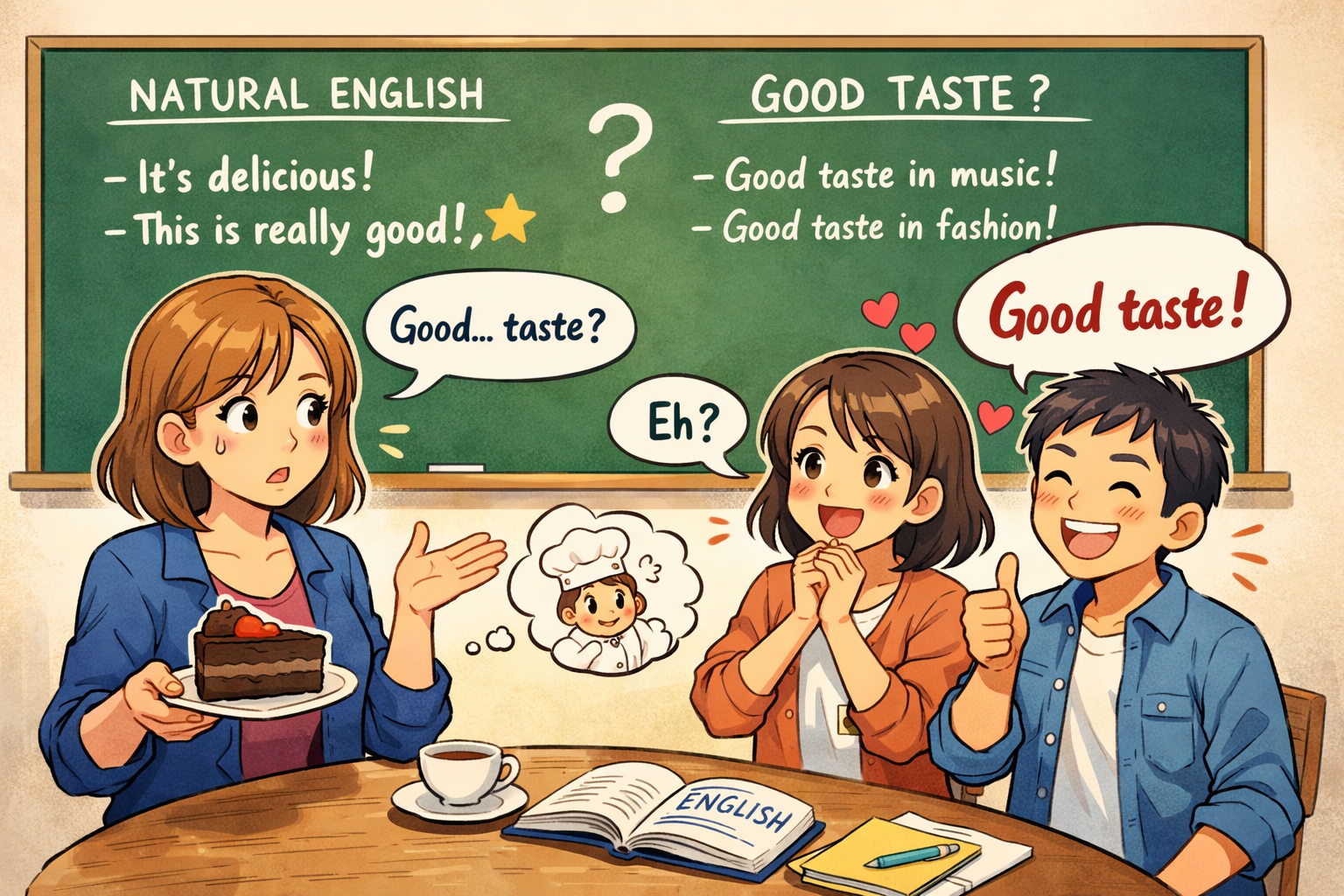
Why English Teachers Secretly Panic When Students Say “Good Taste!”

March 7, 2026

After many years of teaching English in Japan, there are certain phrases that I hear again and again.

One of them is:

“Good taste!”

Students often say this when they like something — food, music, clothes, movies, even a nice café.

For example:

“Wow! This cake is very good. Good taste!”

Or when talking about someone else:

“My friend recommended this restaurant. She has good taste!”

Now here is the interesting part.

In English, “good taste” is not something we usually say to praise food.

When native speakers talk about delicious food, we usually say things like:

  • This tastes great.

  • This is really good.

  • It’s delicious.

  • Wow, that’s amazing.

“Good taste” actually means something a little different.

It usually refers to someone’s sense of style or judgment.

For example:

  • She has good taste in music.

  • He has good taste in clothes.

  • They have good taste in restaurants.

So if someone says “Good taste!” after eating a piece of cake, a native English speaker might feel slightly confused.

They may think you are talking about the chef’s judgment, not the flavor of the cake.

Of course, we will understand what you mean.

But it sounds a little unusual.

These kinds of small differences are very common when learning another language. Many expressions come directly from Japanese thinking.

That’s exactly the kind of thing we practice in conversation classes.

Learning grammar is important, but learning natural expressions is what makes English sound smooth and comfortable.

And who knows…

Next time you try a delicious cake, you might say:

“Wow — this is really good.”

Instead of:

“Good taste!”

In Adjectives, Bad Translation Tags 英会話スクール, 英会話教室, 英語, 福岡市中央区今泉, 南天神英会話
Comment

Shohei's English

November 18, 2024

Shohei Otani made a common mistake.

❌ This is so special moment for me.

⭕️ This is such a special moment for me.

⭕️ This moment is so special for me.

⭕️ This is a very special moment for me.

⭕️ This moment is very special for me.

In Adjectives Tags Shohei Otani, 小谷翔平
Comment

Relax Time

March 10, 2021

A very common mistake Japanese make when speaking English is to say “relax time”.

This is wrong! So, let’s fix the Broken English!

mmc-dran-073.jpg

You, too, Doraemon???

In Adjectives Tags Relax Time, A Relaxing Time
Comment
エンジョイタイムEC-1024x591.jpg

Enjoy

January 15, 2021

How do you say something was 楽しい?

In America, we would say something like:

It was fun.

It was really fun.

There are slang ways to say this, too:

It was a blast.

It was a kick in the pants.

Beer and skittles. (イギリスのスラング)

More formal ways would be:

It was a pleasure.

I had a wonderful time.

Other ways to say something was fun.

I had a good time.

I had a great time.

I had the time of my life.

For some reason, Japanese usually say:

I very enjoyed.

This is, of course, not correct.

Enjoy is not an adjective (形容詞). It is a verb (動詞). What’s more it is a transitive verb (他動詞) which means it needs an object (目的語).

Enjoy

a. …を楽しむ, …で楽しく過ごす (!(1)受け身は⦅まれ⦆ . (2)日本語の「楽しむ」よりも意味の幅が広く, 趣味(の道具)・仕事・時間・人生・人(との交際)・料理など幅広い目的語を取りうる)

▸ enjoy books [a new job, one's pipe] 読書[新しい仕事, パイプでの一服]を楽しむ

▸ How did you enjoy your vacation? 休暇はどうでしたか(≒How was your vacation?)

▸ really [thoroughly] enjoy Tom's companyトムと一緒にとても楽しく過ごす

▸ enjoy one's time in Paris パリで楽しく過ごす

▸ enjoy tennis more [╳better] than baseball野球よりテニスが好きだ

▸ Enjoy your meal! どうぞお召し上がりください (!ウェイターが料理を運んできた時などに言う)

▸ The concert was wonderful. I enjoyed every minute of it. コンサートはすばらしく, そのすべてを楽しむことができた.

Enjoy can also be a reflexive verb (再帰動詞、再帰代名詞を伴う動詞; enjoy oneselfのenjoyなど)

c. 〖~ oneself〗 【場所・パーティなどで】楽しむ, 楽しく過ごす, くつろぐ «at, in»

▸ Welcome, everyone. Enjoy (yourselves). ようこそ皆さん, 楽しんでください (!⦅米・くだけて⦆ ではoneselfが省略されることがある)

▸ Are you enjoying yourself? 楽しんでるかい, 調子はどうだい

▸ enjoy oneselfin the garden [bath] 庭で[風呂に入って]くつろぐ(╳enjoy in the garden [bath]としない).

In the photo above, it says エンジョイ!タイム. How would you translate that?

❌ enjoy time

⭕️ an enjoyable time

Or, a fun time, a great time, a wonderful time, etc.

In Verb, Adjectives Tags 英語で楽しい
Comment
DSC05607.jpeg

How big?

January 4, 2021

Many times I have asked students “How big is your home?” to which they reply, “No, no, no. My home is very small!”

Clearly they didn’t understand the question.

The same thing happens when I ask a simple question like “How tall is your husband?” The student will reply, “No, he’s very short!!!”

Yes, how + adjective can mean なんと・いかに . . . but it’s not that common, つまりその使い方はそんなに使われてない

Look at your dictionary and you will see that the first definition of “how” is どういう方法[手段]で, どのようにして, どんなふうに

▸ How did he get [find] the money?

彼はどのようにしてそのお金を手に入れた[見つけた]のか(!⦅話⦆ では時に強意的にHow on earth [⦅ぞんざいに⦆ the hell, ⦅まれ⦆ ever] did ...? (いったいどのようにして…したのか)のような形で用いる; → hell 1 語法 )

▸ “How did you go to school?” “I went by bike.” 「通学はどうしていたのですか」

「自転車で通っていました」

▸ “How does Ann drive?” “Very carefully.” 「アンの車の運転ぶりはどうですか」

「非常に慎重ですね」

The second definition of how is どのくらい, どれほど. And this is what is being asked by:

How . . . is it?

- big

- old

- tall

- long

- heavy 

- far

For example:

▸ How old is your uncle? おじさんは何歳ですか

▸ How long will she be staying here? 彼女はいつまでここにいるのだろうか

▸ How far is it from Washington to New York? ワシントンからニューヨークまで(距離は)どれくらいありますか

▸ How soon does the movie begin? あとどのくらいで映画は始まるかな

▸ How many visitors are you expecting to come?お客さんは何人くらいの予定でしょうか

▸ How much money do you need? お金はいくら必要ですか

▸ I don't know how long the street is. その通りの長さはわかりません.

So, when you are asked:

How big is your apartment/home?

Don’t say:

✖️ No, it’s small!!!

Say:

⭕️ It’s a 3 LDK.

⭕️ It’s 80 square meters.


Or, when you are asked:

How tall is your husband?

Don’t say:

✖️ No, he’s very short!!!

⭕️ He’s about average height.

⭕️ He’s 170 cm tall. 

⭕️ He’s quite short.

And, when you are asked:

How old is your baby?

Say:

He’s 6 months old. 


In Grammar, Adjectives Tags How + adjective, How+形容詞
Comment
colored-pencils.jpg

Blue Color

December 14, 2018


青色

❌ blue color

→ blue

→ the color blue

❗️blue color = 青色色


赤色

❌ red color

→ red

→ the color red

❗️red color = 赤色色

茶色

❌ brown color

→ brown

→ the color brown

❗️brown color = 茶色色

黄色

❌ yellow color

→ yellow

→ the color yellow

❗️yellow color = 黄色色

In Adjectives Tags Blue color, saying colors in English
Comment
No results found

Instagram

Back at Sri Lanka Nishijin today. Never gets old.
Curry Tiner’s South Indian Chicken & Mutton Curry

I have been following the guy for years on Instagram and have been meaning to go, but the planets never quite seemed to line up. Today they did and thank God for that.

Wow!

Expect a long
Ippodo Tea Shop, Kyōto
Higashi Hongan-ji, Kyōto
All ready for Thanksgiving.

#shochu #imojochu #焼酎 #いも焼酎
Display Cases of Kyoto
Inukaeshi in Kyōto 

京都の犬返し

#Kyoto #Inukaeshi #犬返し #京都 #Machiya #町屋
Walls in Gokusho Machi, Hakata
The 15th of August is the last day of the Bon Festival of the Dead, Japan’s version of Dia de muertos. On this day, Japanese say goodbye to the spirits of their ancestors. Today I say goodbye to my last drop of Yamato Zakura Beni Imo 35%. Forgi
Azaleas at Fukuoka’s Kushida Shrine 

#櫛田神社 #Kushida #springinjapan #Fukuoka
Mugon (Tacit, lit. Without Words) rice shōchū genshu from Sengetsu Distillery of Hitoyoshi, Kumamoto. Aged in cypress casks, I believe, it retains that telltale hinoki scent. I normally don’t drink Kuma-jōchū, but this is lovely. I’ll buy
Another one of my somewhat hard-to-find favorites. Sang Som from Thailand. So smooth. I used to keep a bottle of it at Gamaradi before the pandemic. May have to do so again. Missed it. Missed Mr. Chang.
ブログ RSS
Unknown.jpeg
Featured
4c0a6231-58c1-450e-8f3a-bf718f86ea48.png
September 10, 2026
Win or Beat?
September 10, 2026
Read more →
September 10, 2026
Posessive Pronouns.png
September 2, 2026
Possessive Pronouns
September 2, 2026
Read more →
September 2, 2026
79a452f9-f4a0-4760-886d-544c736d0118.png
April 9, 2026
❌ "It is beautiful sea." — Why This Sentence Sounds Strange in English
April 9, 2026
Read more →
April 9, 2026
Avoiding Should.png
March 28, 2026
Why Many Japanese Avoid “Should” — And Why They Shouldn’t
March 28, 2026
Read more →
March 28, 2026
cde4019a-29a3-48cd-aa3c-880d433105fc.png
March 7, 2026
Why English Teachers Secretly Panic When Students Say “Good Taste!”
March 7, 2026
Read more →
March 7, 2026
c31b89c7-2fdd-441e-87ff-6af1ad634b1d.png
May 9, 2025
Admit vs Accept
May 9, 2025
Read more →
May 9, 2025
Die Of:From:In.png
April 12, 2025
Die Of/From/In
April 12, 2025
Read more →
April 12, 2025
Pan Ya Ya.jpg
November 19, 2024
Pan Ya Ya
November 19, 2024
Read more →
November 19, 2024
Shohei English.jpg
November 18, 2024
Shohei's English
November 18, 2024
Read more →
November 18, 2024
Screenshot 2024-03-12 at 4.30.42.png
March 13, 2024
By My Car
March 13, 2024
Read more →
March 13, 2024
Blog Photo.jpeg
Featured
What about:How about (kuroko).png
September 17, 2026
What About…? vs. How About…?
September 17, 2026
Read more →
September 17, 2026
Blog - Stuff.png
September 16, 2026
The Most Important English Word You Were Never Taught: “Stuff”
September 16, 2026
Read more →
September 16, 2026
American Cursive.png
September 14, 2026
Cursive Writing
September 14, 2026
Read more →
September 14, 2026
426b7067-f48b-47be-8112-182c79de9fa4.png
September 9, 2026
Why English Speakers Say “Twenty Twenty-Six”
September 9, 2026
Read more →
September 9, 2026
Malay Duplication.png
August 29, 2026
Reduplication in Languages
August 29, 2026
Read more →
August 29, 2026
c037c2d6-ac46-420e-abba-47c9bd494cc8.png
August 21, 2026
Katakana Does Not Always Mean English!
August 21, 2026
Read more →
August 21, 2026
Sentence Building Blocks.png
May 17, 2026
Sentence Building Blocks
May 17, 2026
Read more →
May 17, 2026
Why do Fukuoka Schools Celebrate in May.png
May 16, 2026
The May Miracle: Why Fukuoka’s Schools Are All Celebrating Right Now
May 16, 2026
Read more →
May 16, 2026
BC05DF4D-5356-4E91-8CCB-A3F1CDE4C5F2.png
May 10, 2026
15 Things Serious English Students Actually Do
May 10, 2026
Read more →
May 10, 2026
a_colorful_infographic_poster_bright_cartoon_illu.png
April 19, 2026
How Many English Words Do You Know?
April 19, 2026
Read more →
April 19, 2026
word-of-the-day-new.jpg
Featured
couple-2585328_640.jpg
May 23, 2018
In Ages
May 23, 2018
Read more →
May 23, 2018
50e524604a672a893aacf7eead6bc3c5.jpg.gif
May 19, 2018
Wishy-Washy
May 19, 2018
Read more →
May 19, 2018
600px-CousinTree.svg.png
May 19, 2018
Once Removed
May 19, 2018
Read more →
May 19, 2018
93979218f3c25c57a03295c14a6715b7.jpg
May 18, 2018
Assertive vs Aggressive
May 18, 2018
Read more →
May 18, 2018
Resources.jpg
Featured
pe240215.gif
February 29, 2024
Peanuts
February 29, 2024
Read more →
February 29, 2024
Screenshot 2024-02-06 at 4.41.13.png
February 6, 2024
OWAD's Word a Day
February 6, 2024
Read more →
February 6, 2024
January 27, 2021
Beginning, Middle, End
January 27, 2021
Read more →
January 27, 2021
nn_kids_thumbnail_02_154678_f81e2f6d0d7589ff5cda5a641cfb8c23.jpg
December 25, 2020
Nightly News: Kids Edition
December 25, 2020
Read more →
December 25, 2020
history_of_english4.png
September 8, 2020
History of the English Language
September 8, 2020
Read more →
September 8, 2020
nursery-rhymes.jpg
September 3, 2020
Mother Goose
September 3, 2020
Read more →
September 3, 2020
crossword puzzle.png
April 10, 2019
Crossword Puzzles
April 10, 2019
Read more →
April 10, 2019
maxresdefault.jpg
March 25, 2019
Student Recommendations
March 25, 2019
Read more →
March 25, 2019
How to Improve Your English.jpg
February 22, 2019
How to Improve Your English
February 22, 2019
Read more →
February 22, 2019
November 22, 2018
Eigo Beat
November 22, 2018
Read more →
November 22, 2018