• Home
  • 授業料・クラス一覧
  • レッスン内容
  • 今月の休み
  • プロフィール
  • 生徒さんの声
  • 翻訳・編集
  • ブログ
  • Word
  • Resources
  • Mistakes
  • Contact

スピーク英会話サロン【福岡】

  • Home
  • 授業料・クラス一覧
  • レッスン内容
  • 今月の休み
  • プロフィール
  • 生徒さんの声
  • 翻訳・編集
  • ブログ
  • Word
  • Resources
  • Mistakes
  • Contact
  • Menu

Reduplication in Languages

August 29, 2026

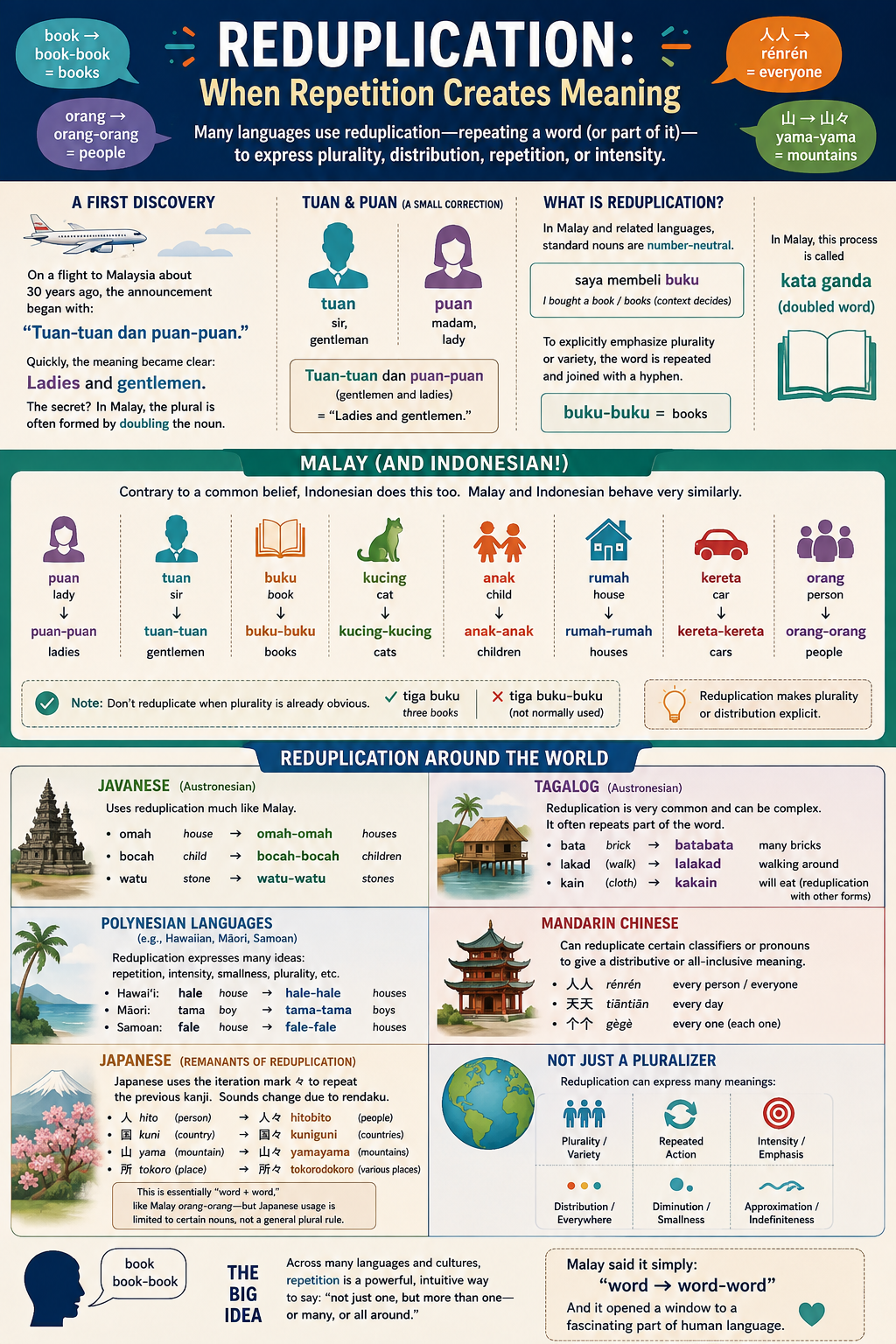
About 30 years ago, I flew to Malaysia for the first time. During the flight, I noticed something interesting.

Before making an announcement, the flight attendant would say:

“Tuan-tuan dan puan-puan.”

I did not speak Malay, but it did not take me long to figure out that this meant “Ladies and gentlemen.”

Later, while traveling around Malaysia, I began comparing signs written in Malay and English. I soon noticed an interesting pattern. Words were sometimes repeated:

buku → buku-buku
book → books

rumah → rumah-rumah
house → houses

anak → anak-anak
child → children

orang → orang-orang
person → people

I was delighted. I had never seen a language make plurals this way before.

Tuan-tuan dan Puan-puan

There was one small detail I learned later.

Tuan means “sir” or “gentleman,” while puan means “madam” or “lady.”

So:

tuan-tuan = gentlemen
puan-puan = ladies

And:

Tuan-tuan dan puan-puan = “Ladies and gentlemen.”

The process of repeating a word like this is called reduplication. In Malay, it is called kata ganda, which basically means a “doubled word.”

Is a Malay Noun Singular or Plural?

Actually, the system is a little more complicated than simply saying that doubling makes a plural.

Malay nouns are usually number-neutral. In other words, buku can mean either “book” or “books.” The meaning often comes from the context.

If you want to make it clear that there is more than one, however, you can repeat the word:

buku → buku-buku

kucing → kucing-kucing
cat → cats

kereta → kereta-kereta
car → cars

But you do not usually need to repeat the noun when the number is already clear.

For example:

tiga buku = three books

You would not normally say tiga buku-buku because tiga (“three”) already tells us that there is more than one book.

What About Indonesian?

I had thought that Indonesian did not use this system. Interestingly, it does.

Malay and Indonesian are closely related languages, and Indonesian also uses reduplication:

buku-buku = books
rumah-rumah = houses
anak-anak = children
orang-orang = people

So this interesting feature is found in both languages.

Other Languages Do It Too

Once I started looking into this, I discovered that Malay is far from alone.

Reduplication is especially common among Austronesian languages, the huge family of languages spoken from Southeast Asia across the Pacific.

Javanese, for example, also uses reduplication:

omah → omah-omah
house → houses

bocah → bocah-bocah
child → children

Tagalog, spoken in the Philippines, uses reduplication too. Its system is more complicated, however. Sometimes only partof a word is repeated. Reduplication can also show repeated actions, intensity and other meanings.

Hawaiian, Māori, Samoan and other Polynesian languages also use different kinds of reduplication.

Even Chinese and Japanese Do Something Similar

Reduplication is not limited to Austronesian languages.

Mandarin Chinese has expressions such as:

人人 (rénrén) = everyone
天天 (tiāntiān) = every day
个个 (gègè) = every one

Here, repetition does not simply make a normal plural. Instead, it gives the idea of every, each, or something happening repeatedly.

Japanese has some interesting examples too:

人 → 人々
hito → hitobito
person → people

国 → 国々
kuni → kuniguni
country → countries

山 → 山々
yama → yamayama
mountain → mountains

所 → 所々
tokoro → tokorodokoro
place → various places

The symbol 々 means that the previous kanji should be repeated. So 人々 is essentially 人 + 人.

Japanese, however, does not use this as a regular way of making plurals. You cannot simply repeat any Japanese noun to mean “more than one.”

More Than Just Plurals

Perhaps the most interesting thing about reduplication is that it can do much more than make nouns plural.

In languages around the world, repeating a word or part of a word can express:

  • more than one

  • variety

  • repeated action

  • intensity

  • “each” or “every”

  • smallness

  • approximation

There seems to be something very natural about using repetition to express more.

English does not normally make plurals this way. We say book → books, not book → book-book.

That may be why buku-buku fascinated me so much when I first encountered it in Malaysia 30 years ago.

It was such a simple idea:

One book? Buku.

Books? Buku-buku.

Sometimes the most interesting things about a foreign language are the little patterns you discover before anyone has even explained them to you.

In Language Learning Tags Malay, Reduplication
Comment
No results found

Instagram

Back at Sri Lanka Nishijin today. Never gets old.
Curry Tiner’s South Indian Chicken & Mutton Curry

I have been following the guy for years on Instagram and have been meaning to go, but the planets never quite seemed to line up. Today they did and thank God for that.

Wow!

Expect a long
Ippodo Tea Shop, Kyōto
Higashi Hongan-ji, Kyōto
All ready for Thanksgiving.

#shochu #imojochu #焼酎 #いも焼酎
Display Cases of Kyoto
Inukaeshi in Kyōto 

京都の犬返し

#Kyoto #Inukaeshi #犬返し #京都 #Machiya #町屋
Walls in Gokusho Machi, Hakata
The 15th of August is the last day of the Bon Festival of the Dead, Japan’s version of Dia de muertos. On this day, Japanese say goodbye to the spirits of their ancestors. Today I say goodbye to my last drop of Yamato Zakura Beni Imo 35%. Forgi
Azaleas at Fukuoka’s Kushida Shrine 

#櫛田神社 #Kushida #springinjapan #Fukuoka
Mugon (Tacit, lit. Without Words) rice shōchū genshu from Sengetsu Distillery of Hitoyoshi, Kumamoto. Aged in cypress casks, I believe, it retains that telltale hinoki scent. I normally don’t drink Kuma-jōchū, but this is lovely. I’ll buy
Another one of my somewhat hard-to-find favorites. Sang Som from Thailand. So smooth. I used to keep a bottle of it at Gamaradi before the pandemic. May have to do so again. Missed it. Missed Mr. Chang.
ブログ RSS
Unknown.jpeg
Featured
4c0a6231-58c1-450e-8f3a-bf718f86ea48.png
September 10, 2026
Win or Beat?
September 10, 2026
Read more →
September 10, 2026
Posessive Pronouns.png
September 2, 2026
Possessive Pronouns
September 2, 2026
Read more →
September 2, 2026
79a452f9-f4a0-4760-886d-544c736d0118.png
April 9, 2026
❌ "It is beautiful sea." — Why This Sentence Sounds Strange in English
April 9, 2026
Read more →
April 9, 2026
Avoiding Should.png
March 28, 2026
Why Many Japanese Avoid “Should” — And Why They Shouldn’t
March 28, 2026
Read more →
March 28, 2026
cde4019a-29a3-48cd-aa3c-880d433105fc.png
March 7, 2026
Why English Teachers Secretly Panic When Students Say “Good Taste!”
March 7, 2026
Read more →
March 7, 2026
c31b89c7-2fdd-441e-87ff-6af1ad634b1d.png
May 9, 2025
Admit vs Accept
May 9, 2025
Read more →
May 9, 2025
Die Of:From:In.png
April 12, 2025
Die Of/From/In
April 12, 2025
Read more →
April 12, 2025
Pan Ya Ya.jpg
November 19, 2024
Pan Ya Ya
November 19, 2024
Read more →
November 19, 2024
Shohei English.jpg
November 18, 2024
Shohei's English
November 18, 2024
Read more →
November 18, 2024
Screenshot 2024-03-12 at 4.30.42.png
March 13, 2024
By My Car
March 13, 2024
Read more →
March 13, 2024
Blog Photo.jpeg
Featured
What about:How about (kuroko).png
September 17, 2026
What About…? vs. How About…?
September 17, 2026
Read more →
September 17, 2026
Blog - Stuff.png
September 16, 2026
The Most Important English Word You Were Never Taught: “Stuff”
September 16, 2026
Read more →
September 16, 2026
American Cursive.png
September 14, 2026
Cursive Writing
September 14, 2026
Read more →
September 14, 2026
426b7067-f48b-47be-8112-182c79de9fa4.png
September 9, 2026
Why English Speakers Say “Twenty Twenty-Six”
September 9, 2026
Read more →
September 9, 2026
Malay Duplication.png
August 29, 2026
Reduplication in Languages
August 29, 2026
Read more →
August 29, 2026
c037c2d6-ac46-420e-abba-47c9bd494cc8.png
August 21, 2026
Katakana Does Not Always Mean English!
August 21, 2026
Read more →
August 21, 2026
Sentence Building Blocks.png
May 17, 2026
Sentence Building Blocks
May 17, 2026
Read more →
May 17, 2026
Why do Fukuoka Schools Celebrate in May.png
May 16, 2026
The May Miracle: Why Fukuoka’s Schools Are All Celebrating Right Now
May 16, 2026
Read more →
May 16, 2026
BC05DF4D-5356-4E91-8CCB-A3F1CDE4C5F2.png
May 10, 2026
15 Things Serious English Students Actually Do
May 10, 2026
Read more →
May 10, 2026
a_colorful_infographic_poster_bright_cartoon_illu.png
April 19, 2026
How Many English Words Do You Know?
April 19, 2026
Read more →
April 19, 2026
word-of-the-day-new.jpg
Featured
couple-2585328_640.jpg
May 23, 2018
In Ages
May 23, 2018
Read more →
May 23, 2018
50e524604a672a893aacf7eead6bc3c5.jpg.gif
May 19, 2018
Wishy-Washy
May 19, 2018
Read more →
May 19, 2018
600px-CousinTree.svg.png
May 19, 2018
Once Removed
May 19, 2018
Read more →
May 19, 2018
93979218f3c25c57a03295c14a6715b7.jpg
May 18, 2018
Assertive vs Aggressive
May 18, 2018
Read more →
May 18, 2018
Resources.jpg
Featured
pe240215.gif
February 29, 2024
Peanuts
February 29, 2024
Read more →
February 29, 2024
Screenshot 2024-02-06 at 4.41.13.png
February 6, 2024
OWAD's Word a Day
February 6, 2024
Read more →
February 6, 2024
January 27, 2021
Beginning, Middle, End
January 27, 2021
Read more →
January 27, 2021
nn_kids_thumbnail_02_154678_f81e2f6d0d7589ff5cda5a641cfb8c23.jpg
December 25, 2020
Nightly News: Kids Edition
December 25, 2020
Read more →
December 25, 2020
history_of_english4.png
September 8, 2020
History of the English Language
September 8, 2020
Read more →
September 8, 2020
nursery-rhymes.jpg
September 3, 2020
Mother Goose
September 3, 2020
Read more →
September 3, 2020
crossword puzzle.png
April 10, 2019
Crossword Puzzles
April 10, 2019
Read more →
April 10, 2019
maxresdefault.jpg
March 25, 2019
Student Recommendations
March 25, 2019
Read more →
March 25, 2019
How to Improve Your English.jpg
February 22, 2019
How to Improve Your English
February 22, 2019
Read more →
February 22, 2019
November 22, 2018
Eigo Beat
November 22, 2018
Read more →
November 22, 2018