• Home
  • 授業料・クラス一覧
  • レッスン内容
  • 今月の休み
  • プロフィール
  • 生徒さんの声
  • 翻訳・編集
  • ブログ
  • Word
  • Resources
  • Mistakes
  • Contact

スピーク英会話サロン【福岡】

  • Home
  • 授業料・クラス一覧
  • レッスン内容
  • 今月の休み
  • プロフィール
  • 生徒さんの声
  • 翻訳・編集
  • ブログ
  • Word
  • Resources
  • Mistakes
  • Contact
  • Menu

When English Becomes a Time Capsule: Funny Wasei-Eigo Clothing Words

March 16, 2026

If you study English in Japan, you probably know that many everyday words come from English.

But sometimes those words mean something a little different from what native speakers expect.

These words are called 和製英語 (wasei-eigo) — English words that were created or changed in Japan.

Some of them are funny. Some are confusing. And some are like a time capsule, preserving English from more than 100 years ago.

Let’s look at a few examples.

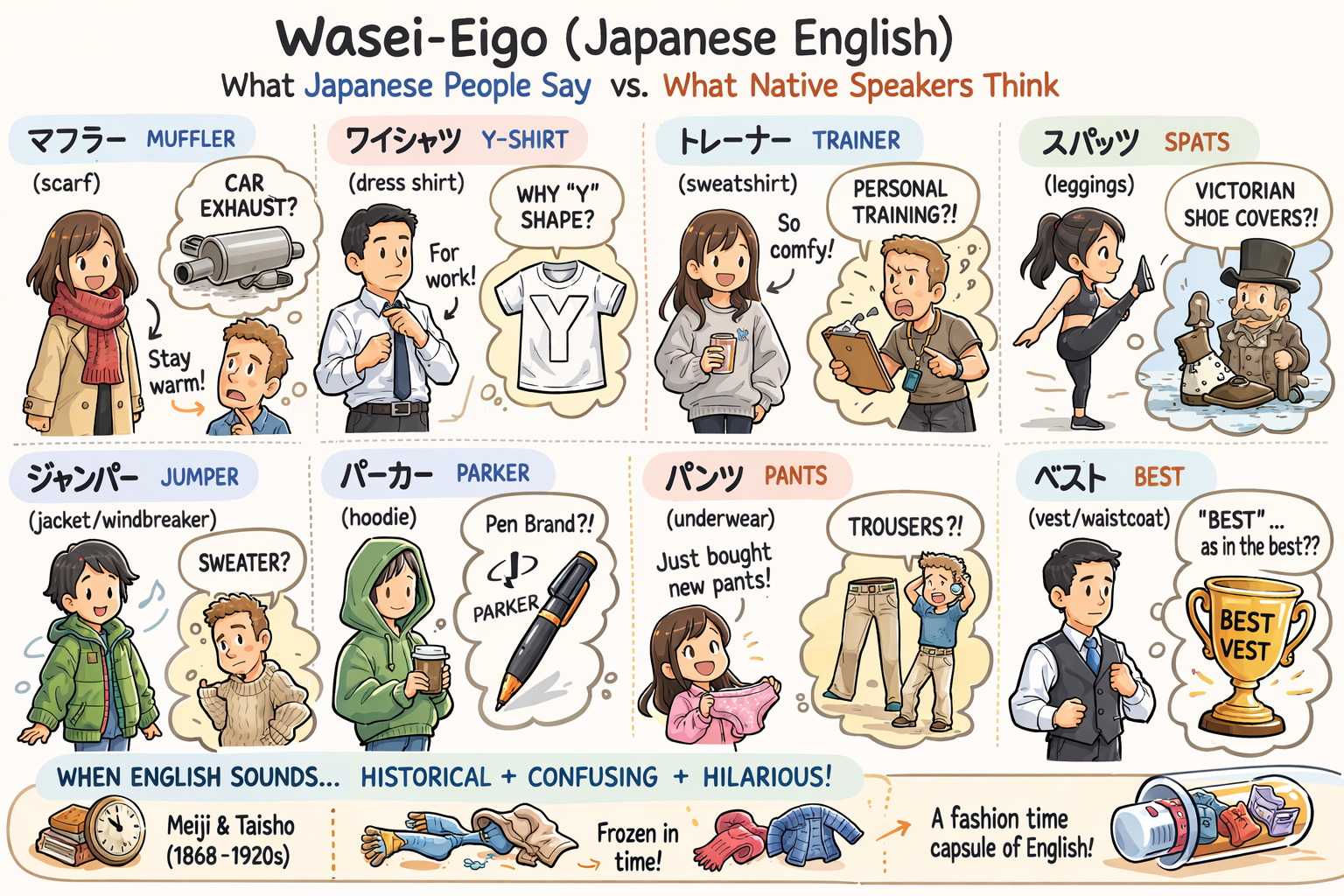
Muffler (マフラー)

In Japan:

マフラー = scarf

But if you say “muffler” in modern English, people will think of a car muffler — the metal part connected to the exhaust.

However, in older British English, “muffler” actually did mean a scarf.

That meaning slowly disappeared in English during the 20th century, but Japan kept it.

So Japanese English preserved an older word that native speakers rarely use today.

A linguistic time capsule!

Y-Shirt (ワイシャツ)

This one has an interesting history.

When Western clothes first came to Japan in the late 1800s, most dress shirts were white.

People heard the words “white shirt.”

Over time, this became:

white shirt → wai shatsu → ワイシャツ

Today, ワイシャツ simply means a dress shirt, even if it isn’t white.

But if you say “Y-shirt” in English, native speakers will probably imagine a shirt shaped like the letter Y.

Trainer (トレーナー)

In Japan:

トレーナー = sweatshirt

But in English, a trainer is usually:

• a fitness coach
• a sports instructor
• (in the UK) running shoes

The Japanese meaning probably comes from the idea of training wear.

Pants (パンツ)

This one often causes funny misunderstandings.

In English:

pants = trousers

In Japanese:

パンツ = underwear

So when a Japanese learner proudly says:

“I bought new pants today.”

A native speaker might imagine new trousers, not underwear!

Parker (パーカー)

In Japan:

パーカー = hoodie

But English speakers usually say hoodie.

The Japanese word probably came from parka, the heavy winter coat with a hood.

Over time the pronunciation changed to パーカー (pākaa).

To English speakers, though, “Parker” sounds like a brand of pen.

Spats (スパッツ)

Today in Japan:

スパッツ = leggings

But in English, spats were something very different.

They were small covers worn over shoes in the late 19th and early 20th century.

You can see them in old photos of bankers, politicians, and early automobile drivers.

Again, Japan kept an old word but gave it a new meaning.

English Frozen in Time

Many English clothing words entered Japan during the Meiji and Taishō periods (late 1800s–early 1900s) when Western fashion first became popular.

At that time, Japan borrowed English words and adapted them to Japanese pronunciation.

But languages continue to change.

Over time, English speakers stopped using some of these words, or their meanings changed.

Japan kept them.

That’s why many wasei-eigo words feel like a little museum of old English.

A linguistic time capsule from another era.

A Small Pronunciation Time Capsule

You can even hear this in pronunciation.

Many Japanese speakers pronounce the “wh-” sound clearly:

• who
• white
• where

Older English once made a stronger distinction between w and wh sounds.

Most modern speakers no longer do this.

So in a strange way, Japanese learners sometimes preserve an older pronunciation of English too!

Why This Is Actually Wonderful

Wasei-eigo isn’t “wrong.” It’s simply how languages change when cultures meet.

English influenced Japanese.

Japanese reshaped those words.

And now those words tell a small story about history, fashion, and language.

So the next time someone in Japan says:

“I need my muffler.”

Don’t imagine a car.

They’re just trying to stay warm.

In Vocabulary Tags 英会話, 英会話福岡市, 英会話英会話, 和製英語
← Shimi: Okinawa’s Unique Ancestor Picnic FestivalWhy “One Hour and a Half” Drives English Teachers Crazy →
No results found

Instagram

Back at Sri Lanka Nishijin today. Never gets old.
Curry Tiner’s South Indian Chicken & Mutton Curry

I have been following the guy for years on Instagram and have been meaning to go, but the planets never quite seemed to line up. Today they did and thank God for that.

Wow!

Expect a long
Ippodo Tea Shop, Kyōto
Higashi Hongan-ji, Kyōto
All ready for Thanksgiving.

#shochu #imojochu #焼酎 #いも焼酎
Display Cases of Kyoto
Inukaeshi in Kyōto 

京都の犬返し

#Kyoto #Inukaeshi #犬返し #京都 #Machiya #町屋
Walls in Gokusho Machi, Hakata
The 15th of August is the last day of the Bon Festival of the Dead, Japan’s version of Dia de muertos. On this day, Japanese say goodbye to the spirits of their ancestors. Today I say goodbye to my last drop of Yamato Zakura Beni Imo 35%. Forgi
Azaleas at Fukuoka’s Kushida Shrine 

#櫛田神社 #Kushida #springinjapan #Fukuoka
Mugon (Tacit, lit. Without Words) rice shōchū genshu from Sengetsu Distillery of Hitoyoshi, Kumamoto. Aged in cypress casks, I believe, it retains that telltale hinoki scent. I normally don’t drink Kuma-jōchū, but this is lovely. I’ll buy
Another one of my somewhat hard-to-find favorites. Sang Som from Thailand. So smooth. I used to keep a bottle of it at Gamaradi before the pandemic. May have to do so again. Missed it. Missed Mr. Chang.
ブログ RSS
Unknown.jpeg
Featured
4c0a6231-58c1-450e-8f3a-bf718f86ea48.png
September 10, 2026
Win or Beat?
September 10, 2026
Read more →
September 10, 2026
Posessive Pronouns.png
September 2, 2026
Possessive Pronouns
September 2, 2026
Read more →
September 2, 2026
79a452f9-f4a0-4760-886d-544c736d0118.png
April 9, 2026
❌ "It is beautiful sea." — Why This Sentence Sounds Strange in English
April 9, 2026
Read more →
April 9, 2026
Avoiding Should.png
March 28, 2026
Why Many Japanese Avoid “Should” — And Why They Shouldn’t
March 28, 2026
Read more →
March 28, 2026
cde4019a-29a3-48cd-aa3c-880d433105fc.png
March 7, 2026
Why English Teachers Secretly Panic When Students Say “Good Taste!”
March 7, 2026
Read more →
March 7, 2026
c31b89c7-2fdd-441e-87ff-6af1ad634b1d.png
May 9, 2025
Admit vs Accept
May 9, 2025
Read more →
May 9, 2025
Die Of:From:In.png
April 12, 2025
Die Of/From/In
April 12, 2025
Read more →
April 12, 2025
Pan Ya Ya.jpg
November 19, 2024
Pan Ya Ya
November 19, 2024
Read more →
November 19, 2024
Shohei English.jpg
November 18, 2024
Shohei's English
November 18, 2024
Read more →
November 18, 2024
Screenshot 2024-03-12 at 4.30.42.png
March 13, 2024
By My Car
March 13, 2024
Read more →
March 13, 2024
Blog Photo.jpeg
Featured
What about:How about (kuroko).png
September 17, 2026
What About…? vs. How About…?
September 17, 2026
Read more →
September 17, 2026
Blog - Stuff.png
September 16, 2026
The Most Important English Word You Were Never Taught: “Stuff”
September 16, 2026
Read more →
September 16, 2026
American Cursive.png
September 14, 2026
Cursive Writing
September 14, 2026
Read more →
September 14, 2026
426b7067-f48b-47be-8112-182c79de9fa4.png
September 9, 2026
Why English Speakers Say “Twenty Twenty-Six”
September 9, 2026
Read more →
September 9, 2026
Malay Duplication.png
August 29, 2026
Reduplication in Languages
August 29, 2026
Read more →
August 29, 2026
c037c2d6-ac46-420e-abba-47c9bd494cc8.png
August 21, 2026
Katakana Does Not Always Mean English!
August 21, 2026
Read more →
August 21, 2026
Sentence Building Blocks.png
May 17, 2026
Sentence Building Blocks
May 17, 2026
Read more →
May 17, 2026
Why do Fukuoka Schools Celebrate in May.png
May 16, 2026
The May Miracle: Why Fukuoka’s Schools Are All Celebrating Right Now
May 16, 2026
Read more →
May 16, 2026
BC05DF4D-5356-4E91-8CCB-A3F1CDE4C5F2.png
May 10, 2026
15 Things Serious English Students Actually Do
May 10, 2026
Read more →
May 10, 2026
a_colorful_infographic_poster_bright_cartoon_illu.png
April 19, 2026
How Many English Words Do You Know?
April 19, 2026
Read more →
April 19, 2026
word-of-the-day-new.jpg
Featured
couple-2585328_640.jpg
May 23, 2018
In Ages
May 23, 2018
Read more →
May 23, 2018
50e524604a672a893aacf7eead6bc3c5.jpg.gif
May 19, 2018
Wishy-Washy
May 19, 2018
Read more →
May 19, 2018
600px-CousinTree.svg.png
May 19, 2018
Once Removed
May 19, 2018
Read more →
May 19, 2018
93979218f3c25c57a03295c14a6715b7.jpg
May 18, 2018
Assertive vs Aggressive
May 18, 2018
Read more →
May 18, 2018
Resources.jpg
Featured
pe240215.gif
February 29, 2024
Peanuts
February 29, 2024
Read more →
February 29, 2024
Screenshot 2024-02-06 at 4.41.13.png
February 6, 2024
OWAD's Word a Day
February 6, 2024
Read more →
February 6, 2024
January 27, 2021
Beginning, Middle, End
January 27, 2021
Read more →
January 27, 2021
nn_kids_thumbnail_02_154678_f81e2f6d0d7589ff5cda5a641cfb8c23.jpg
December 25, 2020
Nightly News: Kids Edition
December 25, 2020
Read more →
December 25, 2020
history_of_english4.png
September 8, 2020
History of the English Language
September 8, 2020
Read more →
September 8, 2020
nursery-rhymes.jpg
September 3, 2020
Mother Goose
September 3, 2020
Read more →
September 3, 2020
crossword puzzle.png
April 10, 2019
Crossword Puzzles
April 10, 2019
Read more →
April 10, 2019
maxresdefault.jpg
March 25, 2019
Student Recommendations
March 25, 2019
Read more →
March 25, 2019
How to Improve Your English.jpg
February 22, 2019
How to Improve Your English
February 22, 2019
Read more →
February 22, 2019
November 22, 2018
Eigo Beat
November 22, 2018
Read more →
November 22, 2018